GST on Services in India: Current Slabs, SAC Codes & Invoicing Rules
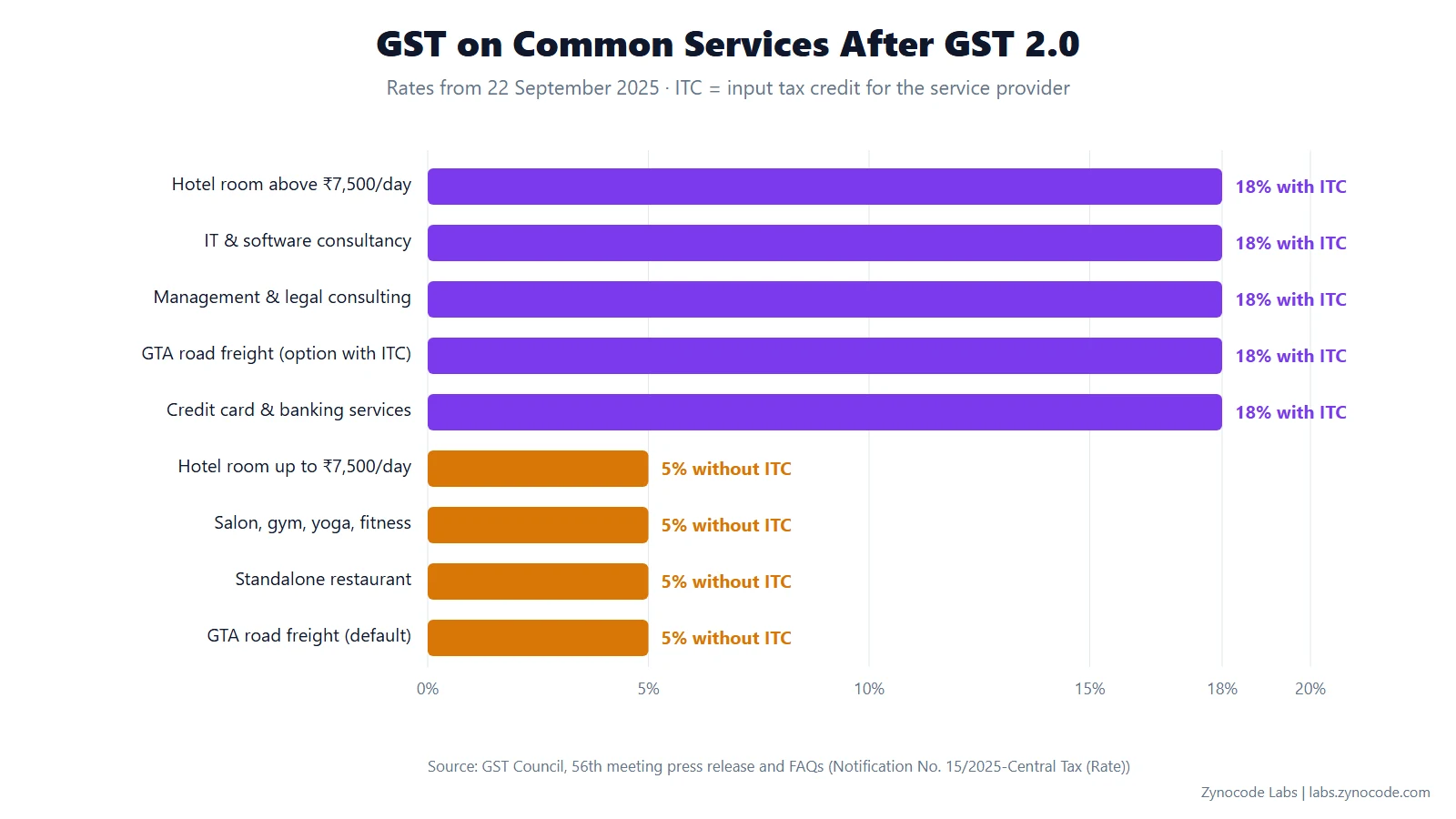
Under GST 2.0 reforms from Notification No. 15/2025-Central Tax (Rate), hotel accommodation up to and including ₹7,500 per unit per day attracts 5% GST without input tax credit, while rooms above ₹7,500 attract 18% with ITC. Standalone restaurants and personal care services also charge 5% without ITC, whereas commercial IT and professional services remain at 18%.
Under the Goods and Services Tax (GST) framework in India, the taxation of services differs fundamentally from the taxation of physical commodities. While goods are classified under the Harmonised System of Nomenclature (HSN), service transactions are organized under a dedicated 6-digit classification system known as the Services Accounting Code (SAC), governed by Chapter 99 of the tariff schedule.
On 22 September 2025, India enacted comprehensive "GST 2.0" rate rationalization reforms through Notification No. 15/2025-Central Tax (Rate), implementing recommendations established during the 56th Meeting of the GST Council. These reforms eliminated intermediate slabs, slashing hotel accommodation up to and including ₹7,500 per day and wellness services down to a merit 5% rate without Input Tax Credit (ITC), while retaining 18% for corporate and professional services. You can verify your exact invoice numbers with our GST Calculator, GST 18% Calculator, and GST 5% Calculator.
What Are SAC Codes and How Are Services Classified?
Every taxable service in India is identified by a unique Services Accounting Code (SAC) administered by the Central Board of Indirect Taxes and Customs (CBIC). Derived from the United Nations Central Product Classification (UNCPC), SAC codes ensure systematic compliance across state and central jurisdictions.
A standard SAC code comprises 6 digits:
- Digits 1 and 2 (Always 99): Identifies the transaction as a service rather than a tangible good.
- Digits 3 and 4 (Heading): Represents the broader service industry sector (such as 9963 for accommodation and food, 9983 for professional and IT services, or 9965 for transport).
- Digits 5 and 6 (Sub-Heading): Details the exact statutory classification of the service performed (such as 996331 for restaurant food services, or 998314 for IT infrastructure design).
The complete classification scope can be verified in the official Explanatory Notes to the Scheme of Classification of Services maintained by the GST Council.
Which GST Rate Slabs Apply to Services After Notification No. 15/2025?
The statutory tax rates for services stem from the principal Notification No. 11/2017-Central Tax (Rate), as amended by Notification No. 15/2025-Central Tax (Rate) (issued 17 September 2025, effective 22 September 2025) and detailed in the 56th GST Council Meeting Recommendations and 56th GST Council FAQs.
The revised GST 2.0 service rate structure operates across four distinct primary categories:
1. Hotel Accommodation Services (Heading 9963, SAC 996311)
Under Notification No. 15/2025-Central Tax (Rate), the earlier 12% rate slab on budget and mid-tier hospitality was abolished. Accommodation taxability now divides strictly across the ₹7,500 threshold:
- Tariff up to and including ₹7,500 per unit per day: The statutory rate is 5% GST (2.5% CGST + 2.5% SGST or 5% IGST). Crucially, this 5% rate applies without Input Tax Credit (ITC). Hotel operators billing under ₹7,500 per day cannot claim input tax offsets on furniture, utilities, cleaning supplies, or commercial leases.
- Tariff above ₹7,500 per unit per day: High-value hotel rooms attract 18% GST (9% CGST + 9% SGST or 18% IGST) with full Input Tax Credit eligibility.
2. Beauty, Salon, Fitness, and Physical Well-Being Services (Heading 9997, Group 99972)
To lower everyday costs for consumers, Notification No. 15/2025-Central Tax (Rate) substituted the tax rates for Group 99972:
- Scope: Covers beauty treatment, hairdressing salons, barbers, health clubs, gymnasiums, fitness studios, and yoga centres.
- Current Rate: 5% GST (2.5% CGST + 2.5% SGST or 5% IGST).
- ITC Condition: Without Input Tax Credit (ITC). The earlier 18% rate with ITC was replaced by a mandatory 5% without ITC, meaning gyms and salon operators cannot claim credit on equipment purchases or facility fit-outs.
3. Goods Transport Agency (GTA) Freight Services (Heading 9965, SAC 996511)
Following the removal of the 12% slab under Notification No. 15/2025-Central Tax (Rate), logistics operators have two clear statutory routes:
- Option 1 (5% without ITC): The default merit rate of 5% GST with no Input Tax Credit. When provided to registered corporate entities, tax is normally discharged by the recipient under the Reverse Charge Mechanism (RCM). If the GTA elects forward charge, it pays 5% without claiming ITC on trucks or fuel.
- Option 2 (18% with Full ITC): GTAs may exercise a formal annual election to pay tax under the forward charge mechanism at the standard rate of 18% GST with full Input Tax Credit on commercial vehicles, capital goods, maintenance, and operating inputs.
4. Restaurant and Food Services (Heading 9963, SAC 996331)
Restaurant taxation rules follow strict anti-evasion principles reaffirmed by the 56th GST Council:
- Standalone Restaurants (AC and Non-AC): Mandatory 5% GST (2.5% CGST + 2.5% SGST) without Input Tax Credit. The GST Council introduced specific explanations to clarify that a standalone eatery cannot declare itself as "specified premises" to charge 18% and claim ITC.
- Restaurants in Specified Premises: Only restaurants located inside premises that provide hotel accommodation with a declared room tariff exceeding ₹7,500 per unit per day are permitted to charge 18% GST with full Input Tax Credit.
- Outdoor Catering: Standard outdoor catering is taxed at 5% without ITC, except when conducted in specified premises charging room tariffs above ₹7,500.
5. IT, Consulting, and Professional Services (Heading 9983)
Software development, SaaS provisioning, cloud data architecture, management consulting, accounting, and engineering design continue under standard corporate taxation:
- Current Rate: Standard 18% GST (9% CGST + 9% SGST or 18% IGST).
- ITC Condition: Full Input Tax Credit allowed. Registered B2B clients can offset the 18% tax against their forward liabilities.
For further foundational rules, consult our GST Calculator India Guide.
How Does Place of Supply Determine CGST, SGST, and IGST?
Under the Integrated Goods and Services Tax (IGST) Act, 2017, the tax structure applied to a service invoice depends entirely on the Place of Supply:
$$\text{Intra-State Supply} = \text{Location of Supplier} \text{ and } \text{Place of Supply in Same State} \implies \text{CGST} + \text{SGST}$$
$$\text{Inter-State Supply} = \text{Location of Supplier} \text{ and } \text{Place of Supply in Different States} \implies \text{IGST}$$
For general business-to-business (B2B) services under Section 12(2) of the IGST Act, the place of supply is the registered location of the recipient. For business-to-consumer (B2C) services where recipient address is unknown, it defaults to the supplier's location.
For location-specific services (such as hotel accommodation or restaurant dining), Section 12(3) dictates that the place of supply is the physical location of the immovable property or restaurant. Consequently, a hotel stay in Bengaluru booked by a traveler from Mumbai is an intra-state supply of Karnataka, subject to Karnataka CGST + SGST, not Maharashtra IGST.
What Do the Official Rate Classifications Show in Summary?
The following table summarizes the statutory rates and credit conditions for primary service categories across India under Notification No. 15/2025-Central Tax (Rate) and principal notifications:
| Service Category | SAC Heading / Group | GST Rate | Tax Split (Intra-State) | IGST (Inter-State) | Input Tax Credit (ITC) | Statutory Notification Basis |
|---|---|---|---|---|---|---|
| Standalone Restaurant (AC / Non-AC) | 996331 | 5% | 2.5% CGST + 2.5% SGST | 5% | Not Allowed | Notif. 11/2017 amended by 56th Council |
| Hotel Room (≤ ₹7,500 per day) | 996311 | 5% | 2.5% CGST + 2.5% SGST | 5% | Not Allowed | Notif. 15/2025-CT(R) (effective 22 Sept 2025) |
| Hotel Room (> ₹7,500 per day) | 996311 | 18% | 9.0% CGST + 9.0% SGST | 18% | Allowed | Notif. 11/2017 & Notif. 15/2025-CT(R) |
| Beauty, Salon, Gym & Yoga | 99972 | 5% | 2.5% CGST + 2.5% SGST | 5% | Not Allowed | Notif. 15/2025-CT(R) (Heading 9997, Group 99972) |
| IT & Software Consultancy | 998314 | 18% | 9.0% CGST + 9.0% SGST | 18% | Allowed | Notif. 11/2017-CT(R) Serial No. 21 |
| Management Consulting | 998311 | 18% | 9.0% CGST + 9.0% SGST | 18% | Allowed | Notif. 11/2017-CT(R) Serial No. 21 |
| GTA Road Freight (Standard / RCM) | 996511 | 5% | 2.5% CGST + 2.5% SGST | 5% | Not Allowed | Notif. 15/2025-CT(R) (Item 4(i)) |
| GTA Road Freight (Forward / Full ITC) | 996511 | 18% | 9.0% CGST + 9.0% SGST | 18% | Allowed | Notif. 15/2025-CT(R) (56th Council FAQ Q60) |
| Credit Card & Banking Finance | 997119 | 18% | 9.0% CGST + 9.0% SGST | 18% | Allowed | Notif. 11/2017-CT(R) & Notif. 12/2017 Entry 27 |
You can learn more about practical commercial invoicing in our GST Calculation Guide India.
How Do You Compute GST Exclusive vs Inclusive Invoicing?
Service providers must correctly structure their fee billing based on whether quotation values include or exclude tax.
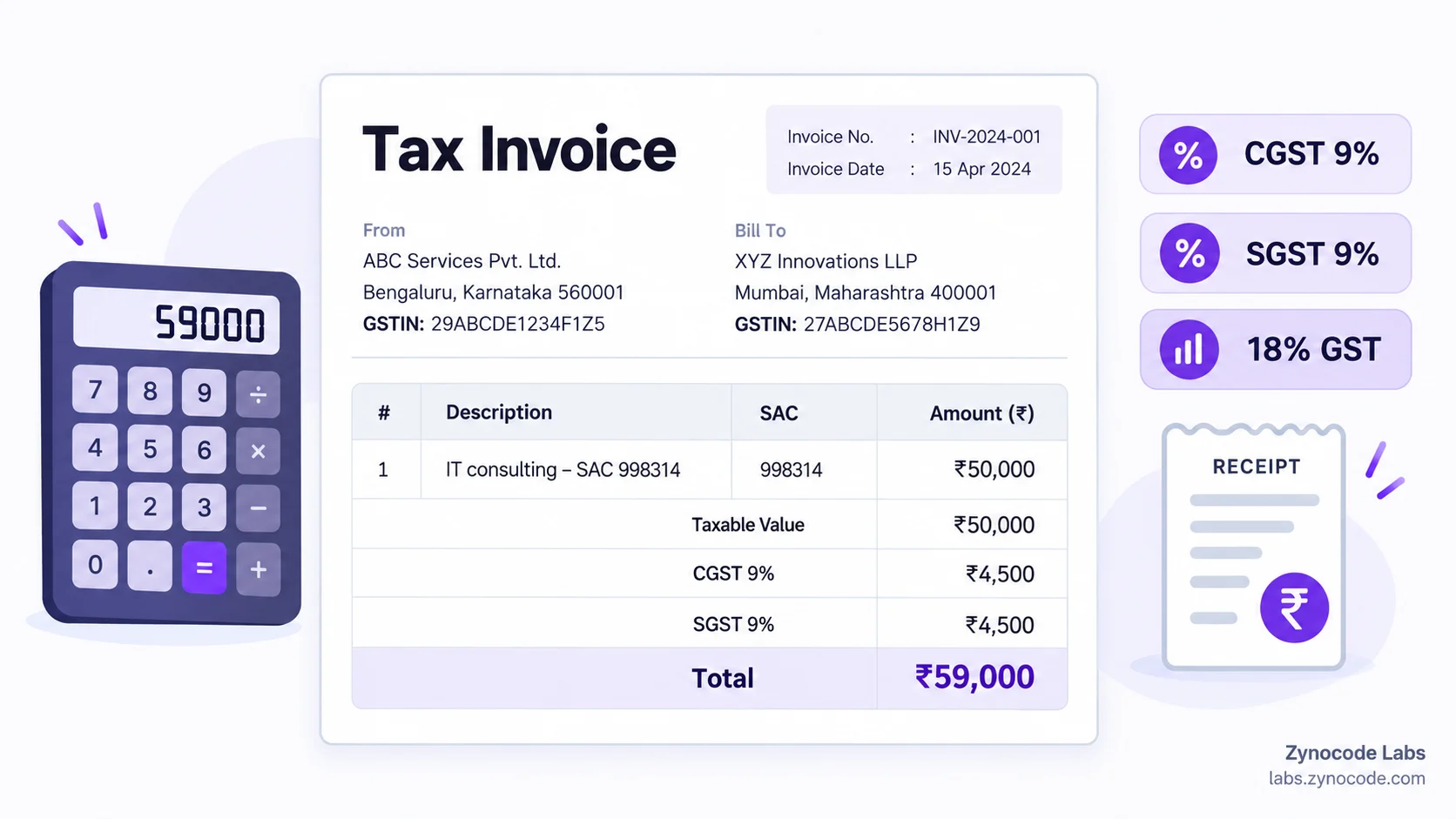
Worked Example 1: GST Exclusive Billing (IT Consulting)
A software consultant bills a client for ₹50,000 for cloud migration services under SAC 998314 (18% GST).
- Taxable Service Value: ₹50,000
- Applicable GST Rate: 18%
$$\text{GST Amount} = \frac{\text{Taxable Value} \times \text{Rate}}{100} = \frac{50,000 \times 18}{100} = ₹9,000$$
- Invoice Breakdown (Intra-State): Net Taxable Amount = ₹50,000; CGST (9%) = ₹4,500; SGST (9%) = ₹4,500; Total Invoice Amount Payable = ₹59,000.
You can verify this exact computation on our GST 18% Calculator page.
Worked Example 2: GST Inclusive Billing (Restaurant Dining)
A diner receives a final bill of ₹1,050 at a standalone restaurant charging 5% GST (SAC 996331). The diner wishes to know the pre-tax food value and the tax component.
- Total Bill Paid: ₹1,050
- Applicable GST Rate: 5%
$$\text{Taxable Value} = \text{Total Amount} \times \left(\frac{100}{100 + \text{Rate}}\right) = 1,050 \times \left(\frac{100}{105}\right) = ₹1,000$$
$$\text{GST Amount} = \text{Total Amount} - \text{Taxable Value} = 1,050 - 1,000 = ₹50$$
- Invoice Breakdown (Intra-State): Net Food Value = ₹1,000; CGST (2.5%) = ₹25; SGST (2.5%) = ₹25; Total Billed Amount = ₹1,050.
You can reproduce this calculation on our GST 5% Calculator page.
What Are the Essential Rules for a Valid GST Service Invoice?
Under Section 31 of the CGST Act, 2017, read with Rule 46 of the CGST Rules, service providers must issue a tax invoice within 30 days from the date of the supply of service (45 days for banking and financial institutions).
Every valid GST service invoice must contain:
- Supplier Identification: Legal business name, registered trade name, physical address, and 15-digit GSTIN.
- Sequential Serial Number: A consecutive invoice number unique for each financial year, containing only letters, numbers, or hyphens (up to 16 characters).
- Date of Issuance: Official date of billing.
- Recipient Identification: Name, address, and GSTIN (for registered B2B clients). For unregistered B2C clients receiving services above ₹50,000, recipient name, address, and delivery state must be stated.
- SAC Code: The 6-digit classification code corresponding to the service provided.
- Value Breakdown: Clear display of total taxable value, applicable tax rates, and separate numerical entries for CGST, SGST, or IGST.
- Place of Supply: Explicit mention of the Place of Supply along with state name.
- Digital Signature: Physical or valid digital signature of the authorized signatory.
Failure to issue a compliant invoice deprives your B2B customers of claiming Input Tax Credit, creating commercial friction and attracting scrutiny under GST audit rules. Before finalizing client quotes, model your tax liability using our GST Calculator.
Frequently asked questions
What is the standard GST rate for services in India?+
The standard default GST rate for commercial, professional, software, and consulting services in India is 18%. This is split into 9% CGST and 9% SGST for intra-state supplies, or charged as 18% IGST for inter-state billing under Notification No. 11/2017-Central Tax (Rate) as amended.
What is a SAC code and where is it used?+
A Services Accounting Code (SAC) is a standardized 6-digit classification system created by the CBIC under Chapter 99 to categorize services for taxation. Every registered service provider must declare the appropriate 6-digit SAC code on their official tax invoices.
What GST rate applies to hotel accommodation after GST 2.0?+
Under Notification No. 15/2025-Central Tax (Rate) effective 22 September 2025, hotel accommodation with a declared tariff less than or equal to ₹7,500 per unit per day attracts 5% GST without Input Tax Credit (ITC). Rooms with tariffs above ₹7,500 per day attract 18% GST with full ITC.
What GST rate applies to beauty salons, gyms, and yoga centres?+
Under Notification No. 15/2025-Central Tax (Rate) amending Heading 9997 (Group 99972), beauty and physical well-being services—including salons, barbers, gymnasiums, fitness centres, and yoga clubs—attract 5% GST without Input Tax Credit (reduced from 18%).
What GST rate applies to standalone restaurant bills?+
Standalone restaurants charge 5% GST without Input Tax Credit (ITC). Under 56th GST Council clarifications, standalone restaurants cannot declare themselves as 'specified premises' to charge 18% with ITC. The 18% rate applies only to restaurants located within hotels with room tariffs exceeding ₹7,500 per unit per day.
What are the post-reform GST options for Goods Transport Agencies (GTA)?+
Under Notification No. 15/2025-Central Tax (Rate), the 12% slab was removed. GTAs have two options: 5% without ITC (payable either under Reverse Charge Mechanism by the recipient or forward charge) or 18% with full Input Tax Credit under forward charge.

Prashant Sharma · Founder & Technology Strategist
Prashant Sharma is the founder of Zynocode IT Solutions, specializing in web development, SEO tooling and generative AI workflows.