FD vs RD: Which Earns More Interest and When Should You Choose Each?
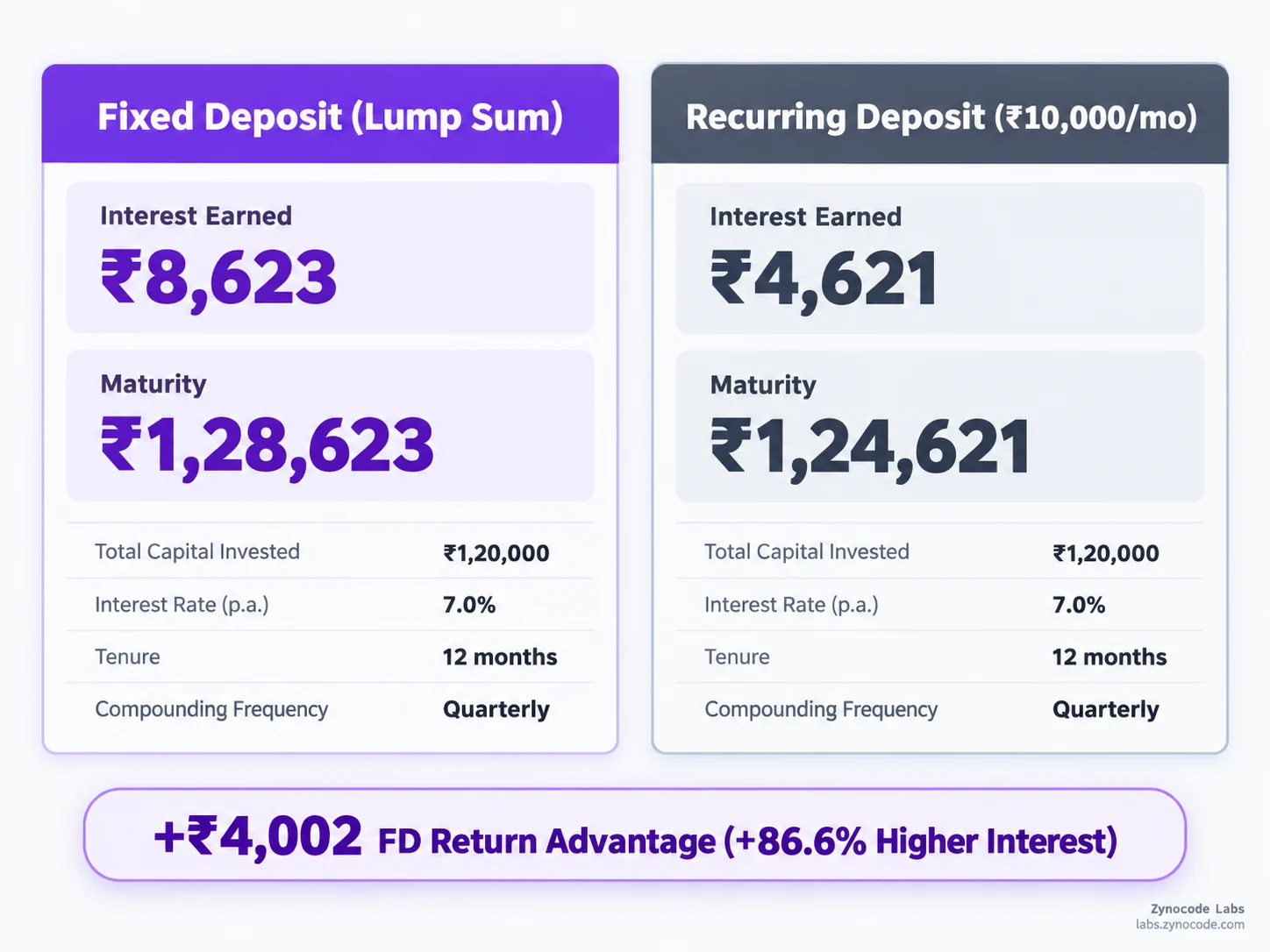
A Fixed Deposit (FD) earns more total interest than a Recurring Deposit (RD) on the same principal because the entire lump sum compounds from day one. Investing ₹1,20,000 in an FD at 7.0% p.a. for 12 months earns ₹8,623, whereas depositing ₹10,000 monthly in an RD earns ₹4,621.
Fixed Deposits (FD) and Recurring Deposits (RD) remain two of the most popular risk-free investment options for capital preservation in India. Both instruments provide guaranteed returns backed by sovereign bank safety, but they cater to fundamentally different cash-flow habits. Choosing between them requires understanding not just the interest rates banks advertise, but how deposit compounding mechanics determine your final maturity value.
If you have a lump-sum windfall, an FD allows you to lock in guaranteed returns immediately. If you earn a predictable monthly salary and want to build savings gradually, an RD automates your monthly discipline. You can model both investment paths side-by-side using our interactive FD and RD Calculator or explore equity-based disciplined savings with our SIP Calculator.
How Does a Fixed Deposit (FD) Function Mathematically?
A Fixed Deposit requires you to deposit a single lump sum of capital with a banking institution for a predetermined tenure ranging from 7 days up to 10 years. In exchange, the bank guarantees a fixed rate of interest that remains locked throughout the term, immune to central bank repo rate cuts or financial market volatility.
In Indian banking, interest on term deposits with tenures exceeding six months compounds on a quarterly basis ($n = 4$). The standard compound interest formula determines the maturity value:
$$A = P \times \left(1 + \frac{r}{n}\right)^{n \times t}$$
Where:
- $A$ is the final maturity amount receivable.
- $P$ is the initial principal lump-sum deposited.
- $r$ is the annual nominal interest rate expressed as a decimal (e.g., $7.0\% = 0.07$).
- $n$ is the compounding frequency per year ($n = 4$ for quarterly compounding).
- $t$ is the deposit duration in years (e.g., 12 months $= 1.0$ year).
Because your entire principal begins accumulating interest on Day 1, quarterly compounding works on the maximum balance from the start of the deposit.
How Does a Recurring Deposit (RD) Calculate Compounding Interest?
A Recurring Deposit operates as an installment-based term deposit. Instead of providing a single large capital amount upfront, you commit to depositing a fixed sum every month for a chosen tenure, typically between 6 months and 10 years.
A common misconception is that an RD calculates simple interest across the whole tenure. In reality, banks compound RD interest quarterly, identical to fixed deposits. However, each monthly installment remains invested for a different duration:
- Installment 1 (Month 1) remains in the bank for the full tenure ($m$ months).
- Installment 2 (Month 2) remains in the bank for $m - 1$ months.
- Installment 3 (Month 3) remains in the bank for $m - 2$ months.
- The final installment (Month $m$) remains in the bank for only 1 month.
The total maturity amount of an RD represents the exact sum of the compounded future values of every individual monthly installment:
$$A = \sum_{i=1}^{m} P \times \left(1 + \frac{r}{4}\right)^{4 \times t_i}$$
Where:
- $m$ is the total number of monthly installments.
- $P$ is the fixed monthly installment amount.
- $t_i = \frac{m - i + 1}{12}$ is the fraction of a year that installment $i$ compounds in the bank account.
- Total interest earned equals the maturity amount $A$ minus total invested capital ($m \times P$).
This exact mathematical formulation powers the calculation engine in our FD and RD Calculator.
Why Does an FD Earn More Interest on the Same Total Capital?
To observe the interest disparity between FD and RD, consider a direct head-to-head comparison where both instruments absorb identical total capital:
- Total Capital Invested: ₹1,20,000
- Illustrative Interest Rate: 7.00% per annum (example rate for calculation purposes)
- Tenure: 12 months (1 year)
- Compounding Frequency: Quarterly ($n = 4$)
In the Fixed Deposit scenario, the investor deposits the entire ₹1,20,000 lump sum on Day 1. In the Recurring Deposit scenario, the investor deposits ₹10,000 at the beginning of every month for 12 months.
| Parameter | Fixed Deposit (Lump Sum) | Recurring Deposit (Monthly Installment) | Difference (FD vs RD) |
|---|---|---|---|
| Total Principal Invested | ₹1,20,000 | ₹1,20,000 (₹10,000 × 12 months) | ₹0 |
| Annual Interest Rate (Example) | 7.00% p.a. | 7.00% p.a. | 0.00% |
| Investment Tenure | 12 months (1 year) | 12 months (1 year) | Same tenure |
| Compounding Frequency | Quarterly ($n = 4$) | Quarterly ($n = 4$) | Same frequency |
| Day 1 Invested Capital | ₹1,20,000 | ₹10,000 | +₹1,10,000 in FD |
| Average Capital Deployed | ₹1,20,000 | ₹65,000 | +₹55,000 in FD |
| Total Maturity Amount | ₹1,28,623 | ₹1,24,621 | +₹4,002 |
| Total Interest Earned | ₹8,623 | ₹4,621 | +₹4,002 (+86.6%) |
The Fixed Deposit delivers ₹8,623 in interest compared to ₹4,621 from the Recurring Deposit—a substantial ₹4,002 advantage (+86.6% higher return).
Why does this happen if both accounts offer an identical 7.0% rate?
The reason lies in the time value of capital:
- In the FD, all ₹1,20,000 earns interest for all 365 days.
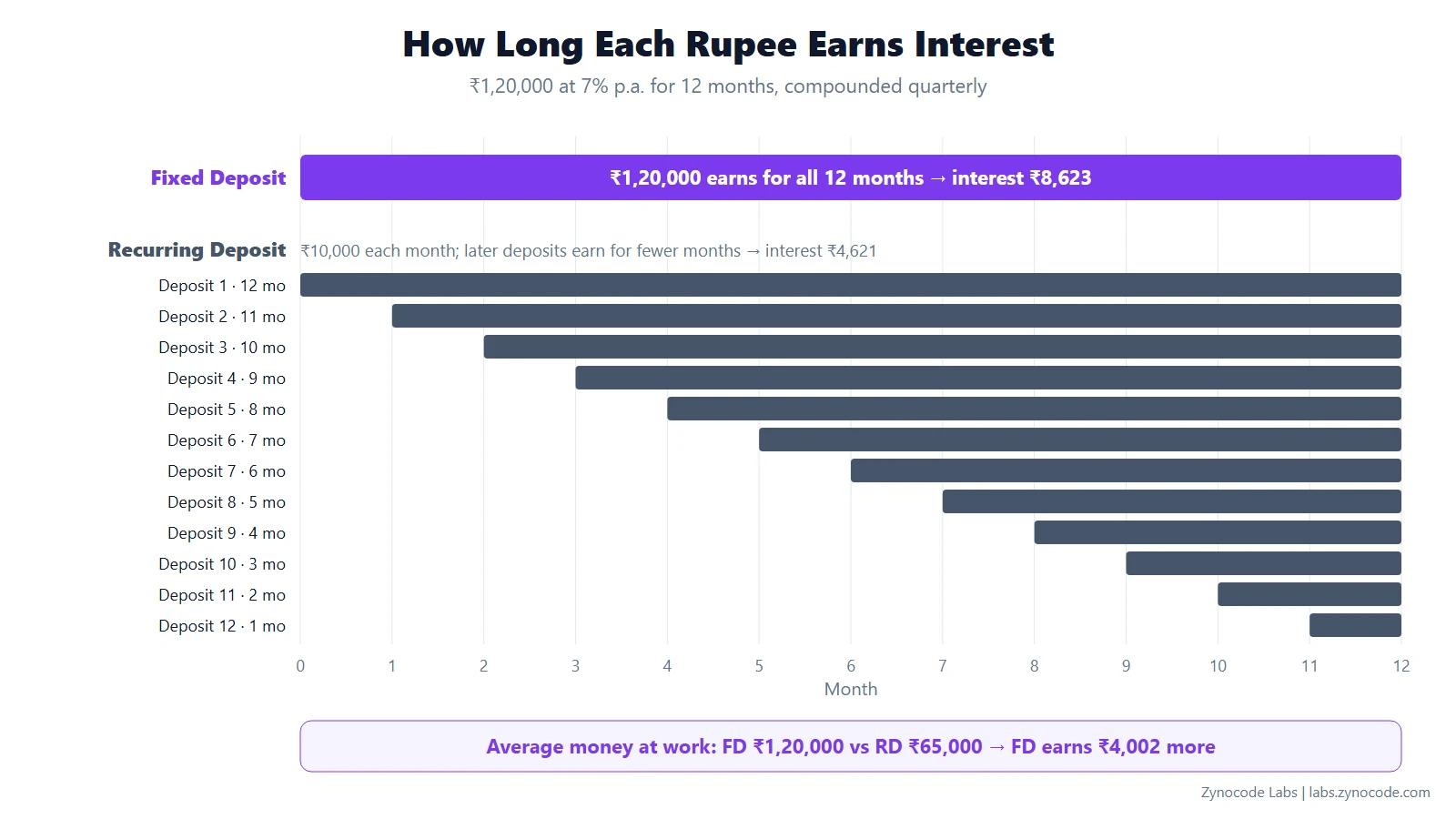
- In the RD, Month 1's ₹10,000 earns interest for 12 months, Month 6's ₹10,000 earns interest for 7 months, and Month 12's ₹10,000 earns interest for barely 30 days.
- The average balance earning interest throughout the year in the RD is only ₹65,000, roughly half the capital deployed in the FD.
This dynamic mirrors the choice between equity mutual fund lump sums and SIPs, detailed in our analysis on SIP vs Lump Sum: Which Is Better?.
What Are the Official DICGC Insurance Limits Protecting Your Money?
Safety of principal is the primary reason conservative investors choose bank deposits over market-linked alternatives. In India, deposit safety is regulated by the Reserve Bank of India through a specialized statutory corporation.
Under guidelines published by the Deposit Insurance and Credit Guarantee Corporation (DICGC), an institution wholly owned by the RBI:
- Coverage Limit: Each depositor in an insured bank is insured up to a maximum limit of ₹5,00,000 (₹5 Lakh) for both principal and interest amounts.
- Aggregation Rule: All deposit accounts held by an individual across all branches of the same bank (including Savings, Current, Fixed Deposit, and Recurring Deposit accounts) are aggregated together under the single ₹5 Lakh ceiling.
- Different Bank Protection: Deposits held in different insured banks are protected separately. If you hold ₹5 Lakh in Bank A and ₹5 Lakh in Bank B, both balances qualify for individual ₹5 Lakh DICGC coverage.
- Ownership Capacity: Deposits held in different ownership capacities (such as an individual account, a joint account with a spouse, or an account as a sole proprietor) are treated as distinct entities for insurance computation.
Because of this statutory cap, investors with substantial liquid capital frequently distribute their deposits across multiple insured banks to ensure 100% of their savings remain under the ₹5 Lakh DICGC insurance umbrella.
How Does Income Tax Apply to FD and RD Returns?
Interest income from both Fixed Deposits and Recurring Deposits is not tax-exempt:
- Tax Slab Treatment: Under Indian income tax laws, interest earned on term deposits is classified under "Income from Other Sources" and added to your total annual taxable income. It is taxed at your applicable personal income tax slab rate.
- TDS Regulations: Banks may deduct TDS on interest above the limit set under the Income-tax Act; check incometax.gov.in for the current threshold. Depositors whose total taxable income falls below the minimum exemption limit can submit Form 15G (for general citizens) or Form 15H (for senior citizens) to instruct the bank not to deduct TDS.
- Post-Tax Yield Reality: Because interest is taxed at your marginal slab rate, a 7.0% nominal FD rate yields an effective post-tax return of approximately 4.83% for an investor in the 31.2% tax bracket.
When Should You Choose an FD Over an RD?
A Fixed Deposit is optimal when you meet the following conditions:
- You Hold Idle Lump-Sum Capital: You received an annual bonus, property sale proceeds, gratuity, or maturity proceeds from another investment.
- Interest Rates Are Peaking: When the central bank is nearing the end of a rate-hiking cycle, booking a long-term multi-year FD locks in high interest rates before rate cuts occur.
- You Seek Regular Income: Senior citizens and retirees can configure an FD with monthly or quarterly non-cumulative interest payouts to generate predictable cash flow.
- You Need Loan Collateral: Commercial banks readily grant overdraft facilities or loans against fixed deposits up to 90% to 95% of the deposit value without breaking the deposit.
When Should You Choose an RD Over an FD?
A Recurring Deposit is the superior tool under these circumstances:
- You Earn a Salaried Monthly Income: You do not have ₹1 Lakh sitting idle in your account today, but you can comfortably save ₹5,000 or ₹10,000 every month on payday.
- You Want Automated Financial Discipline: Setting up a standing instruction for an RD forces you to save before discretionary spending begins.
- You Are Budgeting for Short-Term Goals: If you need to accumulate funds for an annual insurance premium, festival shopping, or a planned vacation 12 months from now, an RD prevents impulsive spending while earning quarterly compounding interest.
- You Want to Avoid Market Timing: An RD functions as a risk-free, guaranteed-return systematic accumulation tool.
To compare how recurring savings behave over longer horizons with market-linked returns, use our SIP Calculator or test varied deposit timelines with our FD and RD Calculator.
Frequently asked questions
Does an FD always earn more interest than an RD?+
Yes, when comparing the same total capital invested over the same tenure at identical interest rates, an FD always generates higher total interest. In an FD, the full lump sum earns compound interest across the entire term, whereas in an RD, only the first installment earns interest for the full term while later installments compound for progressively fewer months.
What is the compounding frequency used by banks for FD and RD?+
Under standard Indian banking conventions, both Fixed Deposits and Recurring Deposits compound interest on a quarterly basis (four times per year). For tenures under six months, banks typically calculate simple interest at maturity.
Are bank deposits in India insured if a bank fails?+
Yes, deposits in insured banks are protected up to ₹5,00,000 per depositor per bank by the Deposit Insurance and Credit Guarantee Corporation (DICGC), an RBI subsidiary. This ₹5 Lakh protection covers cumulative principal and interest held across savings, current, FD, and RD accounts.
Can I break an FD or RD before maturity?+
Most commercial banks permit premature withdrawal of FDs and RDs, but typically impose a penalty of 0.50% to 1.00% deducted from the applicable interest rate for the period the deposit remained with the bank. Certain tax-saving FDs carry a mandatory five-year lock-in period with no premature closure allowed.
How are FD and RD returns taxed in India?+
Interest earned on both FDs and RDs is taxable under Income from Other Sources at the depositor's applicable income tax slab rate. Banks may deduct TDS on interest above the limit set under the Income-tax Act; check incometax.gov.in for the current threshold. Depositors whose total taxable income falls below the minimum exemption limit can submit Form 15G or 15H.

Prashant Sharma · Founder & Technology Strategist
Prashant Sharma is the founder of Zynocode IT Solutions, specializing in web development, SEO tooling and generative AI workflows.