Credit Card Interest in India: How It Is Calculated and the Minimum Due Trap
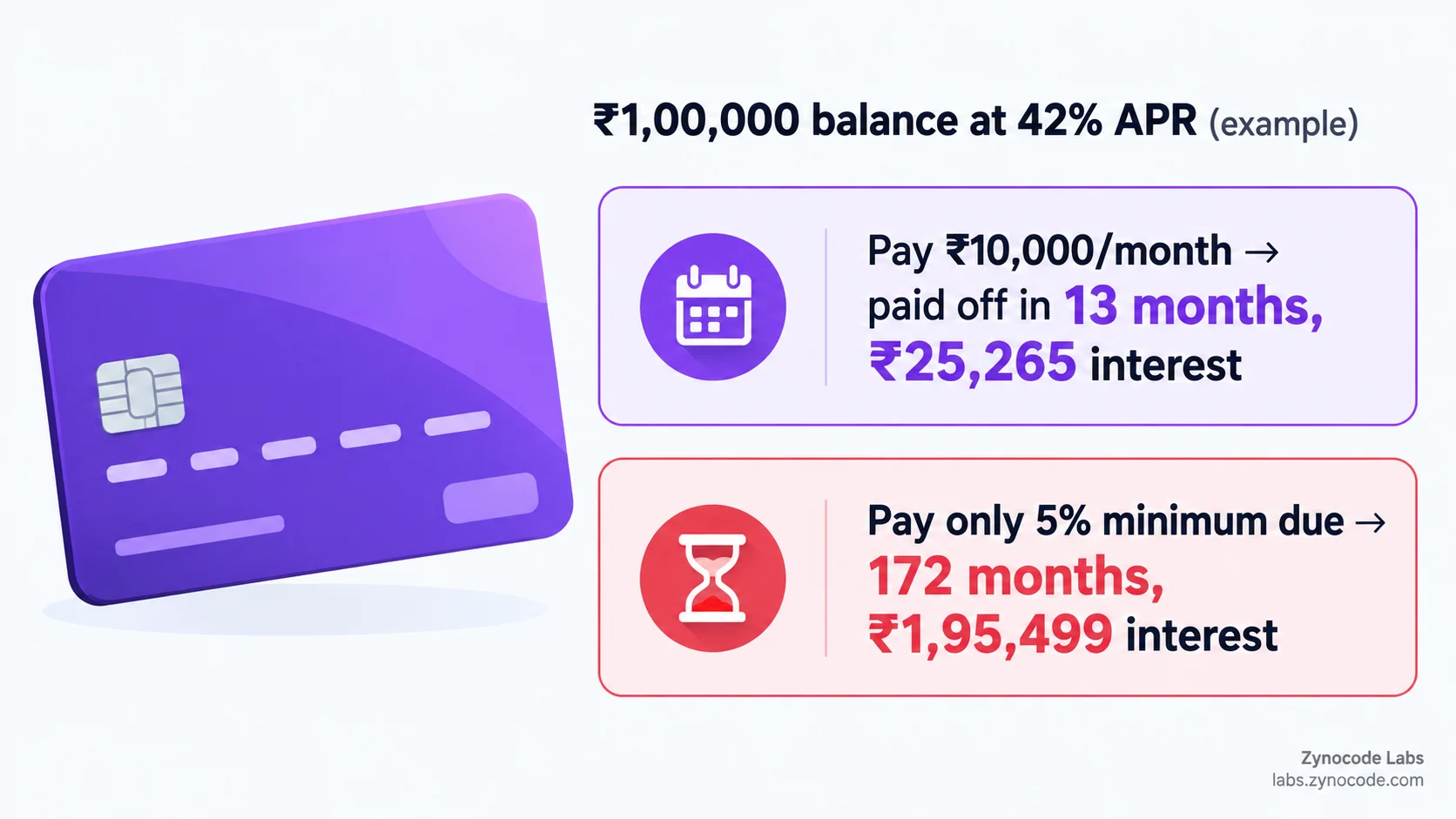
Credit card interest in India is charged on the average daily balance using annualized percentage rates (APR) typically between 36% and 42% per annum, plus 18% GST. Paying only the 5% minimum due on a ₹1,00,000 balance at 42% APR stretches repayment across 172 months and costs ₹1,95,499 in cumulative interest.
A credit card provides unmatched transaction convenience and short-term liquidity, but it also carries the highest borrowing cost of any consumer credit product in India. While personal loans or mortgages typically charge annual interest rates under 15%, credit card annualized percentage rates (APRs) frequently exceed 40% per annum.
The most dangerous financial pitfall for cardholders is the Minimum Amount Due (MAD). Paying the minimum amount satisfies your monthly billing obligation and prevents late payment penalties, but it leaves the remaining principal balance compounding at punitive rates. Understanding how card issuers calculate interest and how payment allocations operate allows you to break free from high-cost debt. You can simulate your repayment timeline with our Credit Card Payoff Calculator and compare multiple debt elimination strategies using our Debt Payoff Calculator.
What Are the Official RBI Rules on Credit Card Interest and Minimum Due?
In India, credit card operations and consumer protections are statutorily regulated under the Master Direction – Credit Card and Debit Card – Issuance and Conduct Directions, 2022 issued by the Reserve Bank of India (RBI).
The Master Direction establishes strict conduct rules under Section 9 (Interest rates and other charges) that all scheduled commercial banks and Non-Banking Financial Companies (NBFCs) must follow:
1. Suspension of the Interest-Free Credit Period (Section 9(b)(iii))
The interest-free grace period (typically 20 to 50 days) applies only if the total bill amount is paid in full on or before the due date. The Master Direction mandates that card issuers must specifically explain in the Most Important Terms and Conditions (MITC) that:
Once this period is suspended, every new purchase made with the card begins accruing daily interest immediately from the date of the transaction.
2. Mandatory Negative Amortization Safeguard (Section 9(b)(ii))
The RBI mandates that lenders cannot configure the Minimum Amount Due in a manner where debt expands over time:
Under the RBI's regulatory Annex, the Minimum Amount Due must be sufficient to cover all accrued interest, all statutory taxes and fees, plus a portion of the principal. This ensures that the card balance actually decreases, albeit very slowly, and prevents lenders from compounding interest upon unpaid taxes or penalty charges.
3. Mandatory Warning Legend on Statements (Section 9(b)(iii))
To caution borrowers against revolving debt traps, card issuers must display this exact warning prominently across all physical and electronic billing statements:
4. Transparent Quoting of Annualized Percentage Rates (Section 9(b)(i))
Card issuers are required to quote the Annualized Percentage Rate (APR) rather than just a misleading monthly interest rate (e.g., stating 42.0% p.a. rather than solely 3.5% per month), with equal prominence given to both annual fees and interest charges.
Why Does 18% GST Apply to Credit Card Interest?
Many borrowers assume that credit card interest is tax-free because interest on savings deposits or home loans does not incur GST. However, credit card debt is subject to distinct statutory tax rules.
Under Entry 27 of Notification No. 12/2017-Central Tax (Rate), standard banking services involving deposits, loans, or advances are exempt from GST only in so far as the consideration is represented by interest or discount. Crucially, the statute includes an explicit carve-out:
Because of this statutory exception, finance charges, cash advance charges, and interest on credit cards are classified as taxable banking services under SAC 997119, subject to standard 18% GST (9% CGST + 9% SGST or 18% IGST). If your monthly interest charge is ₹3,500, an additional ₹630 in GST is added directly to your bill, increasing your total monthly borrowing cost.
How Does the Daily Reducing Balance Formula Work?
When you revolve a balance or pay less than the total statement amount, lenders compute interest using the Average Daily Balance method across your billing cycle:
$$\text{Monthly Interest} = \frac{\text{Transaction Amount} \times \text{Monthly Rate} \times 12 \times \text{Number of Days}}{365}$$
$$\text{Total Monthly Finance Charge} = \text{Monthly Interest} + (\text{Monthly Interest} \times 18\% \text{ GST})$$
For example, if you carry a ₹1,00,000 balance at an illustrative 42.0% APR (3.5% monthly), the first month's pure interest charge is ₹3,500. Adding 18% GST (₹630) brings the total monthly financing deduction to ₹4,130 before a single rupee reduces your principal debt.
To compare how credit card repayment dynamics differ from traditional structured bank loans, explore our guides on How to Calculate Loan EMI and Home Loan Prepayment: Reduce EMI or Tenure?.
What Do the Exact Numbers Show: Fixed Payment vs Minimum Due?
To understand how payment velocity alters your financial health, consider an illustrative worked scenario based on typical Indian retail card terms:
- Card Balance: ₹1,00,000
- Illustrative Interest Rate: 42.0% APR (3.50% per month)
- Scenario A: Fixed monthly installment of ₹5,000 (modeled via Credit Card Payoff Calculator)
- Scenario B: Accelerated fixed monthly installment of ₹10,000
- Scenario C: Paying Minimum Amount Due only (assumed at 5% of monthly balance with a ₹500 floor)
Note: The [Credit Card Payoff Calculator](/tools/credit-card-payoff-calculator) models fixed monthly payments where installments remain constant. The minimum due scenario models a declining payment as your balance falls.
| Metric | Scenario A: Fixed ₹5,000/mo | Scenario B: Fixed ₹10,000/mo | Scenario C: Minimum Due Only (5%) | Difference (B vs C) |
|---|---|---|---|---|
| Initial Balance | ₹1,00,000 | ₹1,00,000 | ₹1,00,000 | — |
| Annualized APR | 42.0% | 42.0% | 42.0% | — |
| Monthly Payment Type | Fixed Amount | Fixed Amount | Declining (5% of balance) | — |
| Starting Monthly Payment | ₹5,000 | ₹10,000 | ₹5,000 | +₹5,000 in B |
| Final Monthly Payment | ₹5,000 | ₹10,000 | ₹500 (Floor) | +₹9,500 in B |
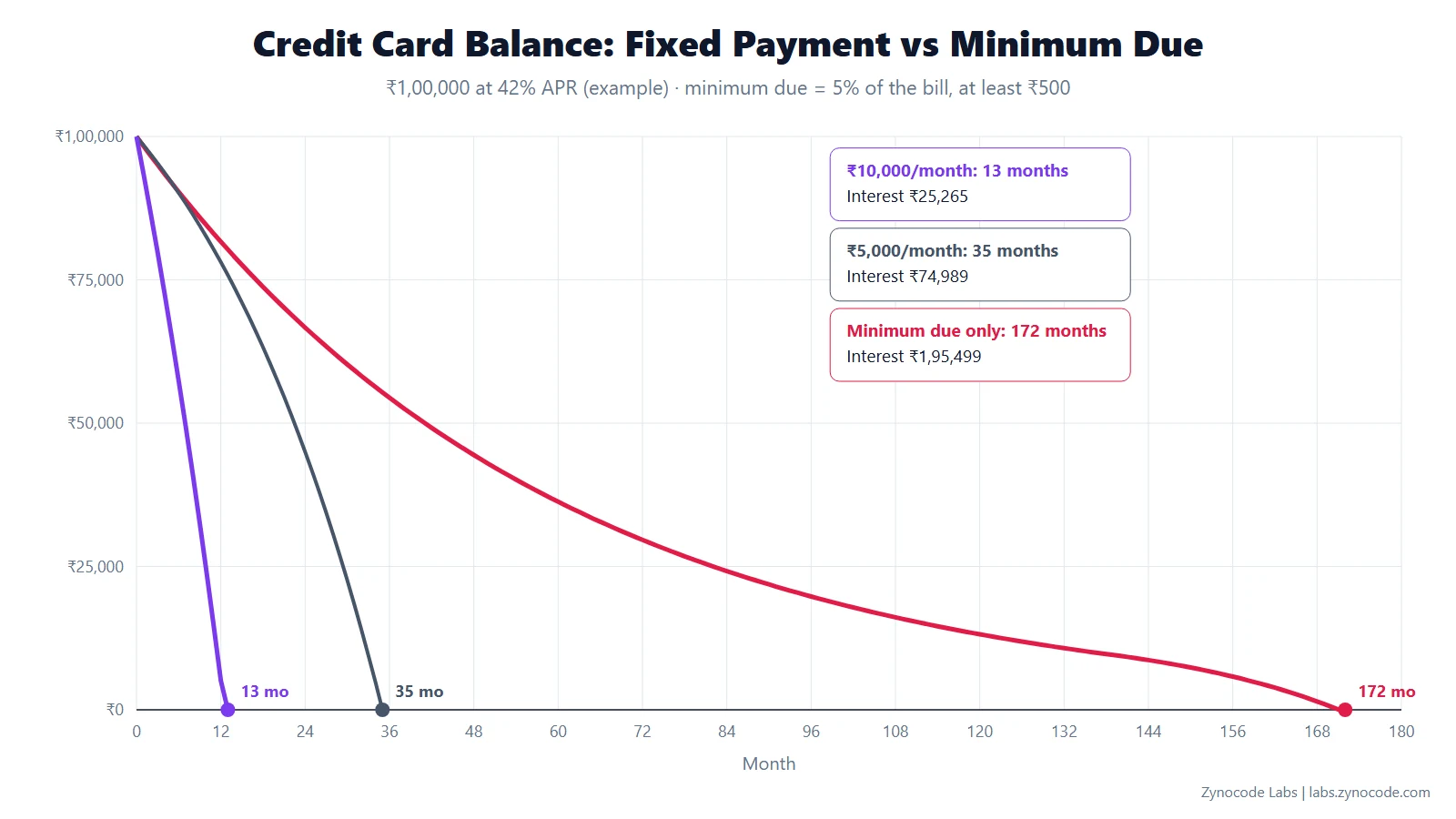
| Payoff Duration | 35 months (2.9 yrs) | 13 months (1.1 yrs) | 172 months (14.3 yrs) | Saved 159 months (13.2 yrs) |
| Total Interest Paid | ₹74,989 | ₹25,265 | ₹1,95,499 | Saved ₹1,70,234 |
| Total Amount Repaid | ₹1,74,989 | ₹1,25,265 | ₹2,95,499 | Saved ₹1,70,234 |
The mathematical contrast is staggering:
- The Minimum Due Trap: Paying only the minimum due stretches debt repayment across 172 months (over 14 years) and results in ₹1,95,499 in interest—nearly double the original principal borrowed.
- Fixed Payment Acceleration: Paying a constant ₹10,000 each month closes the entire obligation in just 13 months with ₹25,265 in interest, saving ₹1,70,234 compared to minimum payments.
- Double Payment Power: Increasing your monthly payment from ₹5,000 to ₹10,000 cuts payoff time by 22 months and saves ₹49,724 in interest.
Why Does the Minimum Due Payment Decline Over Time?
The mathematical flaw of the Minimum Amount Due lies in its variable percentage structure. As you make payments and your principal balance decreases from ₹1,00,000 to ₹80,000, your 5% minimum payment drops from ₹5,000 to ₹4,000. When your balance reaches ₹40,000, your payment falls to ₹2,000.
Because your payment shrinks alongside your balance, you never achieve payment velocity. The borrower remains trapped in an extended tail of high interest payments, with months 60 through 172 spent paying negligible principal amounts against ongoing interest fees.
How Can You Eliminate Credit Card Debt Strategically?
If you currently carry revolving credit card debt, use the following execution playbook to eliminate the balance systematically:
- Adopt a Fixed Payment Rule: Never pay the variable minimum printed on your statement. Pick a fixed target (such as ₹5,000 or ₹10,000) and pay that identical amount every month regardless of what the minimum due shows.
- Halt Discretionary Card Spending: Remember that your interest-free grace period is suspended. Every coffee, dinner, or online purchase added to the card starts accumulating daily interest from Day 1. Switch entirely to debit or UPI until the card balance reads ₹0.
- Use the Debt Avalanche Method: If you have balances across multiple credit cards, order them by highest APR first. Pay the minimum required on other cards while channeling all excess monthly cash toward the highest-rate balance. You can map out this plan on our Debt Payoff Calculator.
- Explore Low-Cost Consolidation: If your credit score remains intact, taking a structured personal loan or balance transfer at 12% to 15% to pay off a 42% credit card can save substantial interest and establish a disciplined, fixed repayment schedule.
Before choosing an payoff plan, enter your balances and rates into our Credit Card Payoff Calculator to visualize your payoff timeline and total interest savings.
Frequently asked questions
How is credit card interest calculated in India?+
Interest is computed on a daily outstanding balance method using the formula: (Outstanding Amount × Monthly Interest Rate × 12 × Number of Days) / 365, or via the quoted Annualized Percentage Rate (APR). In addition, 18% GST applies to all finance charges.
What happens to the interest-free grace period if I only pay the minimum due?+
Under RBI Master Direction guidelines, the interest-free credit period is immediately suspended if any previous balance remains unpaid. Interest is charged retrospectively from the transaction date on all past unpaid amounts and on all new purchases until the total balance is cleared.
Why does paying only the minimum due take so many years to clear debt?+
Because the Minimum Amount Due (MAD) is typically set at around 5% of the total balance, the bulk of your payment goes toward accrued interest and taxes rather than principal reduction. As your balance slowly declines, the required minimum drops as well, stretching repayment over more than a decade.
Does GST apply to credit card interest in India?+
Yes. While interest on standard bank loans and deposits is exempt from GST, credit card finance charges are explicitly excluded from this exemption under Entry 27 of Notification No. 12/2017-Central Tax (Rate). An 18% GST is levied on all finance charges, late payment fees, and card processing fees.
What is the mandatory warning RBI requires on credit card statements?+
Under Section 9(b)(iii) of the RBI Master Direction on Credit Cards, card issuers must prominently display this warning: 'Making only the minimum payment every month would result in the repayment stretching over months / years with consequential compounded interest payment on your outstanding balance'.

Prashant Sharma · Founder & Technology Strategist
Prashant Sharma is the founder of Zynocode IT Solutions, specializing in web development, SEO tooling and generative AI workflows.