Home Loan Prepayment: Should You Reduce EMI or Loan Tenure?
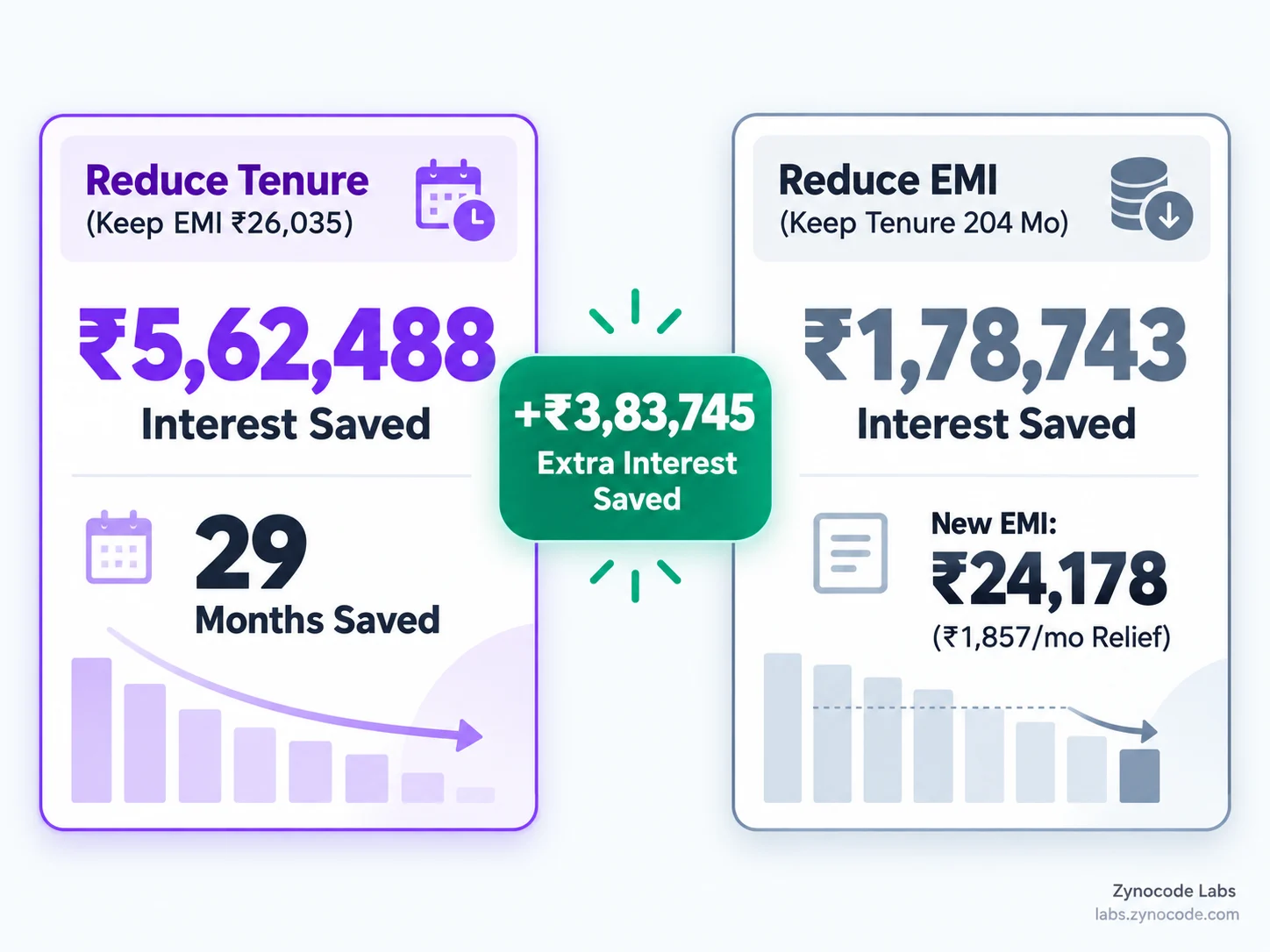
When prepaying a home loan, keeping your EMI constant and reducing the loan tenure saves significantly more interest. On a ₹30 Lakh loan at 8.5% over 20 years, prepaying ₹2 Lakh at Year 3 saves ₹5,62,488 and cuts 29 months if you reduce tenure, compared to saving ₹1,78,743 if you reduce EMI.
When you make a lump-sum part-prepayment toward your home loan, your lender offers two adjustment choices: reduce your monthly installment (EMI) or shorten the remaining loan tenure. While both options reduce your outstanding debt, the long-term financial consequences differ by hundreds of thousands of rupees. Understanding how reducing-balance amortization functions allows you to choose the strategy that best matches your financial goals.
Prepaying early in your loan schedule delivers maximum benefit because loan amortization front-loads interest charges. By applying capital directly toward principal reduction, you eliminate future compound interest on that amount. You can evaluate your repayment baseline with our Loan Amortization Schedule and EMI Calculator.
What Happens Inside the Amortization Schedule During Prepayment?
Every home loan installment covers two components: monthly interest on the outstanding principal balance and a principal repayment portion that chips away at the principal. Lenders calculate monthly interest using the standard reducing-balance formula:
$$\text{Monthly Interest} = \text{Outstanding Principal} \times \left(\frac{\text{Annual Interest Rate}}{12 \times 100}\right)$$
In the opening years of a long-term mortgage, interest represents the overwhelming majority of your monthly installment. For example, in Month 1 of a ₹30 Lakh loan at 8.5% annual interest over 20 years, your EMI is ₹26,035. Of this amount, ₹21,250 pays interest and only ₹4,785 reduces principal.
When you execute a part-prepayment, 100% of the prepaid capital goes directly toward reducing the outstanding principal balance. The lender does not allocate any portion of your prepayment to future interest. Immediately following the prepayment transaction, your outstanding loan balance drops, causing the interest calculation for every subsequent month to decrease.
If you want to master the foundational mechanics of loan installments, explore our detailed guide on How to Calculate Loan EMI.
Should You Choose Option A: Keep EMI Constant and Shorten Tenure?
Option A retains your established monthly installment amount while reducing the number of remaining monthly payments. Because your outstanding principal has dropped, the interest portion of your regular EMI immediately shrinks, leaving a much larger fraction of your monthly payment to attack the remaining principal balance.
This creates an accelerating debt-payoff spiral:
- The lump-sum prepayment reduces the principal balance immediately.
- The regular monthly EMI generates a larger principal reduction in Month 37 and beyond.
- Rapid principal reduction shortens the loan schedule by multiple years.
- Total interest paid across the loan life collapses substantially.
Tenure reduction represents the purest form of interest minimization. It does not alter your household monthly budget, requiring no change to your active lifestyle or spending patterns, while liberating you from debt years ahead of schedule.
Should You Choose Option B: Retain Loan Tenure and Lower Monthly EMI?
Option B preserves your original loan maturity date while re-amortizing the reduced principal balance over the remaining term. Because the outstanding debt is now smaller, the monthly payment required to extinguish the loan by the scheduled date decreases.
This choice targets cash-flow optimization rather than interest minimization:
- Your monthly cash outflow immediately falls, increasing your disposable income.
- The lower EMI provides financial relief if your household expenses have risen or your income is volatile.
- The principal amortizes at the original, slower rate across the remaining months.
- Total interest savings are substantially smaller compared to tenure reduction.
Choosing to lower your EMI can be a strategic move if you intend to invest the monthly difference into higher-yielding growth assets, or if you require an emergency buffer for unexpected living costs. However, if the cash freed up is absorbed by lifestyle inflation, you forgo significant interest savings.
What Do the Exact Numbers Show for a ₹30 Lakh Home Loan?
To demonstrate the real-world impact of both prepayment strategies, consider a practical scenario based on standard Indian retail banking figures:
- Original Loan Amount: ₹30,00,000 (₹30 Lakh)
- Interest Rate: 8.50% per annum (floating)
- Original Tenure: 20 years (240 months)
- Prepayment Amount: ₹2,00,000 (₹2 Lakh)
- Prepayment Timing: End of Year 3 (Month 36)
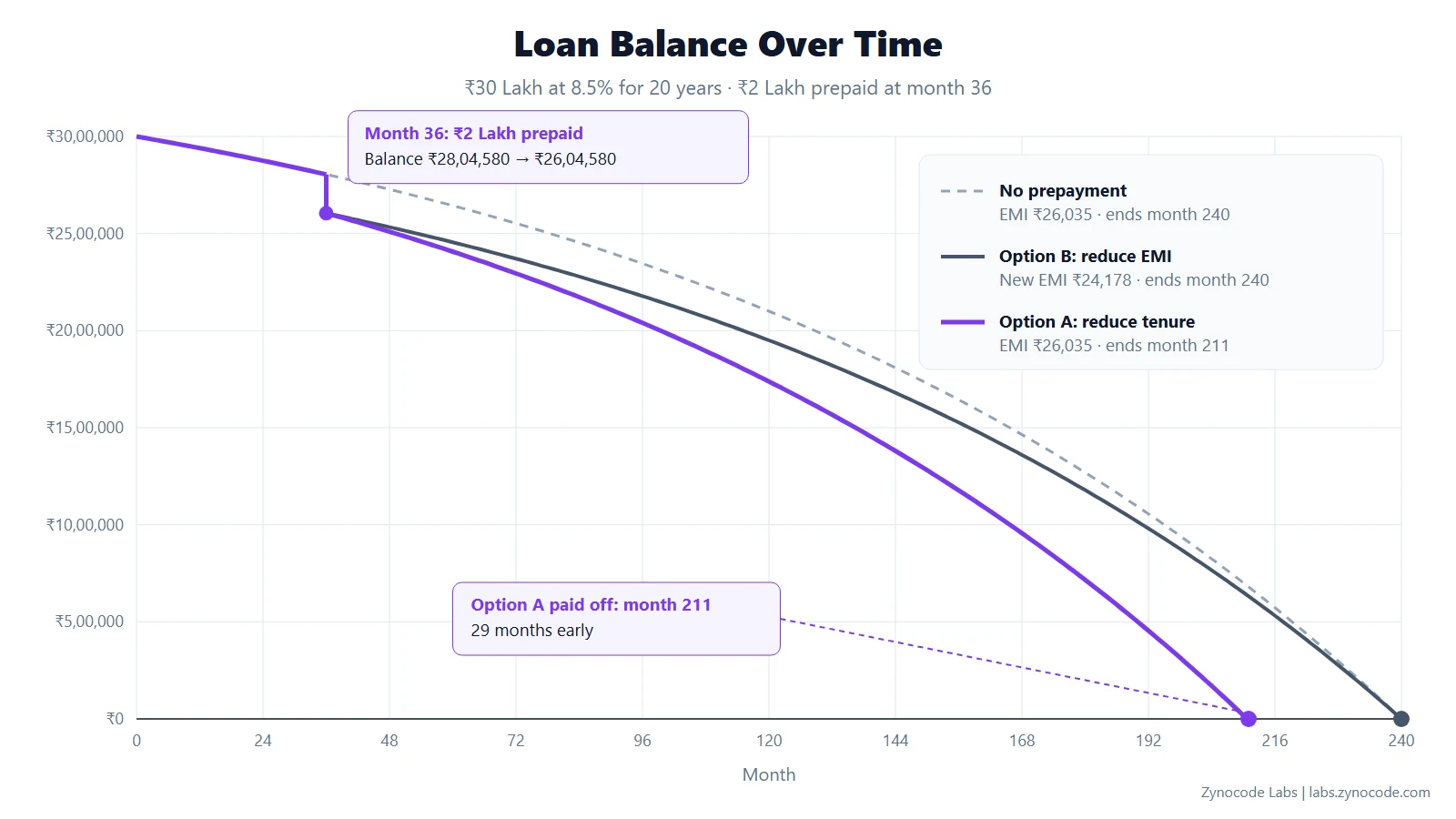
Before prepayment, the borrower pays an EMI of ₹26,035. Over the first 36 months, the borrower has paid ₹9,37,247 in total installments (₹7,41,827 interest and ₹1,95,420 principal), leaving an outstanding principal balance of ₹28,04,580. The ₹2,00,000 prepayment instantly drops this balance to ₹26,04,580 entering Month 37.
You can verify these baseline numbers and repayment curves directly on our Home Loan EMI ₹30 Lakh page and the Loan Amortization Schedule.
| Metric | Baseline (No Prepayment) | Option A: Reduce Tenure (Keep EMI) | Option B: Reduce EMI (Keep Tenure) |
|---|---|---|---|
| Initial Principal | ₹30,00,000 | ₹30,00,000 | ₹30,00,000 |
| Interest Rate | 8.50% p.a. | 8.50% p.a. | 8.50% p.a. |
| Original Tenure | 240 months (20 yrs) | 240 months (20 yrs) | 240 months (20 yrs) |
| Monthly EMI (Months 1–36) | ₹26,035 | ₹26,035 | ₹26,035 |
| Prepayment at Month 36 | ₹0 | ₹2,00,000 | ₹2,00,000 |
| Remaining Balance (Month 37) | ₹28,04,580 | ₹26,04,580 | ₹26,04,580 |
| New Monthly EMI (Months 37+) | ₹26,035 | ₹26,035 (Unchanged) | ₹24,178 (Reduced) |
| Monthly Cash Flow Relief | ₹0 | ₹0 | ₹1,857 / month |
| Remaining Tenure from Month 37 | 204 months | 175 months | 204 months |
| Total Loan Tenure | 240 months | 211 months | 240 months |
| Time Saved | 0 months | 29 months (2.4 years) | 0 months |
| Total Interest Paid | ₹32,48,327 | ₹26,85,839 | ₹30,69,584 |
| Total Repayment (Principal + Interest) | ₹62,48,327 | ₹56,85,839 | ₹60,69,584 |
| Total Interest Saved | ₹0 | ₹5,62,488 | ₹1,78,743 |
| Extra Interest Saved over Option B | — | ₹3,83,745 | — |
The mathematical conclusion is decisive: on an identical ₹2,00,000 capital prepayment, Option A saves ₹5,62,488 in interest, whereas Option B saves ₹1,78,743. Keeping the EMI constant delivers an extra ₹3,83,745 in total interest savings and retires the mortgage 2 years and 5 months earlier.
What Are the Official RBI Rules on Home Loan Prepayment Charges?
Borrowers frequently ask whether Indian lenders can legally charge penalties for prepaying a loan. The regulatory framework issued by the Reserve Bank of India (RBI) establishes clear statutory prohibitions.
Current Regulation: RBI Directions, 2025
The current comprehensive regulatory standard is the Reserve Bank of India (Pre-payment Charges on Loans) Directions, 2025 (Circular RBI/2025-26/64, reference DoR.MCS.REC.38/01.01.001/2025-26), issued on July 2, 2025. These Directions apply to all loans and advances sanctioned or renewed on or after January 1, 2026.
Under paragraph 4 and paragraph 5 of these Directions:
- Entities Covered: The Directions apply to all commercial banks (excluding payments banks), co-operative banks, Non-Banking Financial Companies (NBFCs), and All India Financial Institutions (AIFIs).
- Floating-Rate Loans to Individuals (Non-Business): For all loans granted for purposes other than business to individuals, with or without co-obligant(s), an RE shall not levy pre-payment charges.
- No Lock-in & Source Freedom: This prohibition applies irrespective of the source of funds used for pre-payment (whether from personal savings or refinancing), applies to both partial prepayment and full foreclosure, and permits no minimum lock-in period.
- Dual/Special Rate Loans: The prohibition applies if the loan is on a floating rate at the time of pre-payment.
- Business Loans to Individuals & MSEs (Tier 1 Lenders): Commercial banks (excluding Small Finance Banks, Regional Rural Banks, and Local Area Banks), Tier 4 Primary (Urban) Co-operative Banks, NBFC-Upper Layer (NBFC-UL), and AIFIs shall not levy any pre-payment charges on floating-rate business loans to individuals and Micro and Small Enterprises (MSEs).
- Business Loans to Individuals & MSEs (Tier 2 Lenders): Small Finance Banks, Regional Rural Banks, Tier 3 Primary (Urban) Co-operative Banks, State Co-operative Banks, Central Co-operative Banks, and NBFC-Middle Layer (NBFC-ML) shall not levy any pre-payment charges on such loans with a sanctioned amount or limit up to ₹50 lakh.
- Lender-Initiated Actions: Regulated Entities are strictly prohibited from charging pre-payment fees when pre-payment is effected at the instance of the lender, and cannot retrospectively levy fees that were previously waived.
Regulatory History for Older Loans (Sanctioned Before 2026)
For loans sanctioned prior to January 1, 2026, previous regulatory circulars established the groundwork and remain deemed in force for their respective historical periods:
- Home Loans (2012): Under RBI Circular DBOD.No.Dir.BC.107/13.03.00/2011-12, issued June 5, 2012, scheduled commercial banks were prohibited from charging foreclosure charges or pre-payment penalties on floating-rate home loans.
- All Term Loans to Individuals (2014): Under RBI Circular DBOD.Dir.BC.No.110/13.03.00/2013-14, issued May 7, 2014, the RBI extended the ban on foreclosure charges and pre-payment penalties across all scheduled commercial banks to cover all floating-rate term loans sanctioned to individual borrowers.
How Do You Decide Which Strategy Fits Your Financial Life?
While mathematics favors tenure reduction, your personal balance sheet dictates the practical decision. Evaluate the following decision criteria before contacting your lender:
When to Select Tenure Reduction:
- You have steady, predictable employment or business income.
- Your existing monthly EMI fits comfortably within 30% to 40% of your net monthly take-home pay.
- You have already funded an emergency liquid reserve of 6 to 12 months of living expenses.
- Your primary objective is becoming 100% debt-free as early as possible.
- You want to maximize the guaranteed post-tax return on your surplus capital.
When to Select EMI Reduction:
- Your household is experiencing a reduction in cash flow or anticipate higher medical or educational costs.
- You are transitioning to single-income status or preparing for parental leave.
- You have disciplined investment acumen and can consistently channel the ₹1,857 monthly difference into high-conviction growth assets that outpace the home loan interest rate.
- You want to lower your mandatory debt-to-income ratio to qualify for emergency credit or personal obligations.
What Are the Most Effective Prepayment Strategies Beyond Lump Sums?
You do not need to wait for a large ₹2 Lakh windfall to accelerate your mortgage payoff. Three structured prepayment techniques produce comparable savings with minimal strain on your monthly budget:
- The Annual 13th EMI Strategy: Paying just one additional EMI each calendar year directly against principal can cut a 20-year home loan by 3 to 4 years and save several lakhs in cumulative interest.
- The 5% Annual Step-Up: Increasing your EMI by 5% every year in tandem with salary increments drastically shortens repayment schedules without requiring lump-sum capital infusions.
- Round-Up Payments: Rounding your monthly installment up to the nearest thousand (for instance, paying ₹27,000 instead of ₹26,035) consistently trims principal every 30 days.
Before committing capital, run your numbers through our interactive Loan Amortization Schedule to observe month-by-month principal and interest breakdown graphs. If you are also managing revolving credit balances alongside your mortgage, prioritize high-rate unsecured debt first using our guide on Credit Card Interest & Minimum Due in India.
Frequently asked questions
Is it better to reduce EMI or tenure after a home loan prepayment?+
Reducing tenure is mathematically superior for minimizing total interest costs. Keeping your monthly EMI constant channels a larger portion of every subsequent payment toward principal reduction. Reducing EMI lowers monthly cash commitments but stretches compound interest over the remaining loan term.
Do Indian lenders charge prepayment penalties on home loans?+
Under the Reserve Bank of India (Pre-payment Charges on Loans) Directions, 2025 (RBI/2025-26/64, effective January 1, 2026), commercial banks (excluding payments banks), co-operative banks, NBFCs, and AIFIs cannot levy pre-payment charges on floating-rate loans granted to individuals for non-business purposes. For older loans, historical RBI circulars from June 5, 2012 and May 7, 2014 prohibit penalties on floating-rate individual term loans.
How much interest do you save by prepaying ₹2 Lakh on a ₹30 Lakh loan?+
On a ₹30 Lakh loan at 8.5% interest for 20 years, a ₹2 Lakh prepayment at month 36 saves ₹5,62,488 if you reduce loan tenure, cutting repayment by 29 months. If you reduce EMI instead, the new monthly EMI drops from ₹26,035 to ₹24,178, saving ₹1,78,743.
When does choosing EMI reduction make financial sense?+
Choosing EMI reduction makes sense if you experience a drop in household income, face increased non-discretionary expenses, or need immediate monthly cash flow relief. However, if your budget allows you to maintain the current installment, tenure reduction yields substantially greater long-term wealth preservation.
Which tool reproduces these exact prepayment calculations?+
You can reproduce these calculations using the Loan Amortization Schedule tool by setting the extra payment field to ₹2,00,000 at month 36, or verify the monthly installment on the Home Loan EMI ₹30 Lakh page.

Prashant Sharma · Founder & Technology Strategist
Prashant Sharma is the founder of Zynocode IT Solutions, specializing in web development, SEO tooling and generative AI workflows.