MD5 vs SHA-256: Differences, Collision Vulnerabilities & Modern Security Rules
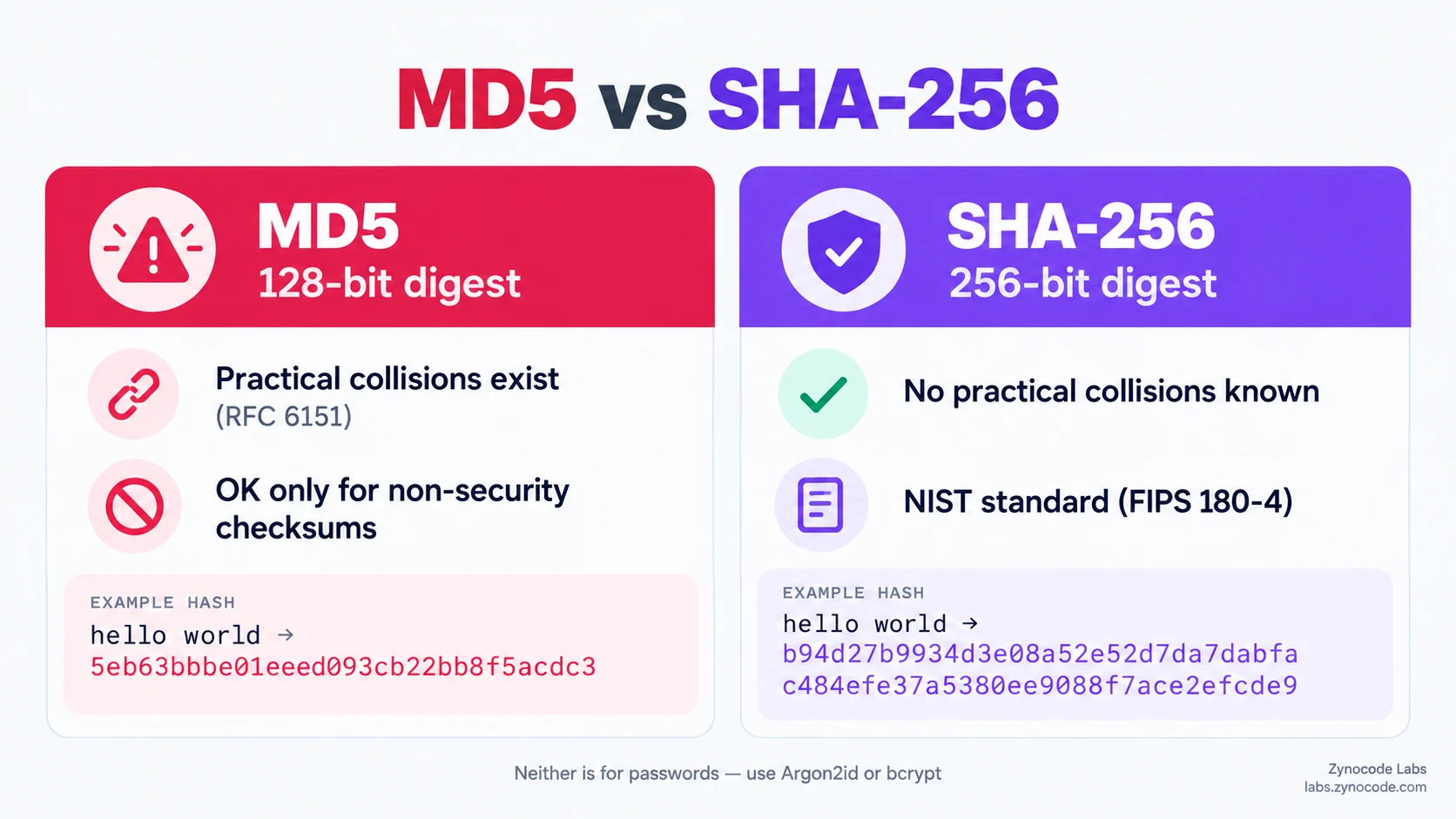
SHA-256 is a cryptographically secure 256-bit hash algorithm approved by NIST (FIPS 180-4) with zero known practical collisions. MD5 is a 128-bit legacy digest broken by practical collision attacks (RFC 6151). MD5 is acceptable solely for non-security checksums like accidental file corruption checks; neither algorithm is suitable for password storage.
Cryptographic hash functions are mathematical primitives that map data streams of arbitrary size into compact, fixed-size bit strings known as message digests or checksums. In modern software engineering, hash functions power digital signatures, TLS certificates, git commit histories, blockchain transactions, and data integrity verification.
Two of the most widely recognized hash algorithms in computing history are MD5 (Message Digest 5) and SHA-256 (Secure Hash Algorithm 256-bit). While software developers still encounter both across legacy source repositories and operating system utilities, their cryptographic security profiles are fundamentally different.
You can compute MD5, SHA-1, SHA-256, and SHA-512 checksums instantly in your browser using our client-side Hash Generator. If you need to evaluate password hashing architectures, explore our Bcrypt Generator or inspect encoded token payloads using our Base64 Encoder & Decoder.
What Standards Define MD5 and SHA-256?
The technical specifications and security standards governing MD5 and SHA-256 are documented by the IETF and the United States National Institute of Standards and Technology (NIST):
- [RFC 1321: The MD5 Message-Digest Algorithm](https://datatracker.ietf.org/doc/html/rfc1321): Authored by Ronald Rivest in April 1992, defining the 128-bit MD5 algorithm as an evolutionary enhancement over MD4.
- [RFC 6151: Updated Security Considerations for the MD5 Algorithm](https://datatracker.ietf.org/doc/html/rfc6151): Published in March 2011 by the IETF, formally advising against the use of MD5 in any protocol or application requiring collision resistance.
- [NIST FIPS 180-4: Secure Hash Standard (SHS)](https://csrc.nist.gov/pubs/fips/180-4/upd1/final): The authoritative federal standard specifying the SHA-2 family of hash algorithms, including SHA-224, SHA-256, SHA-384, and SHA-512.
- [NIST SP 800-107 Rev. 1: Recommendation for Applications Using Approved Hash Algorithms](https://csrc.nist.gov/pubs/sp/800/107/r1/final): Details federal guidelines on security strength, collision resistance, and preimage resistance for cryptographic implementations.
Together, these specifications establish the cryptographic boundaries separating obsolete legacy digests from modern secure hash standards.
How Do the Mathematical Properties Compare?
Both algorithms operate on the Merkle–Damgård construction, dividing input data into sequential 512-bit (64-byte) blocks and processing each block through iterative compression rounds. However, their internal word sizes, mathematical primitives, and output lengths produce radically different cryptographic strengths.
The following table contrasts the core technical specifications of MD5 and SHA-256:
| Technical Specification | MD5 (RFC 1321) | SHA-256 (NIST FIPS 180-4) |
|---|---|---|
| Standardization Authority | IETF (RFC 1321, 1992) | NIST (FIPS 180-4, 2015) |
| Output Digest Length | 128 bits (16 bytes, 32 hex chars) | 256 bits (32 bytes, 64 hex chars) |
| Internal Block Size | 512 bits (64 bytes) | 512 bits (64 bytes) |
| Word Size | 32 bits | 32 bits |
| Compression Rounds | 64 rounds (4 operations × 16 steps) | 64 rounds (6 logical functions) |
| State Vector Size | 128 bits (four 32-bit words: A, B, C, D) | 256 bits (eight 32-bit words: A through H) |
| Endianness | Little-endian byte ordering | Big-endian byte ordering |
| Security Status | Cryptographically Broken (RFC 6151) | Secure & NIST Approved |
| Collision Strength | 0 bits (collisions demonstrated) | 128 bits of security strength |
| Preimage Strength | $\approx 2^{123}$ operations (theoretical) | 256 bits of security strength |
| Approved for Signatures | No (Strictly Prohibited) | Yes (FIPS compliant) |
Internal Architecture: MD5 (RFC 1321)
MD5 initializes four 32-bit state registers with fixed constants:
$$A = \text{0x67452301}, \quad B = \text{0xEFCDAB89}, \quad C = \text{0x98BADCFE}, \quad D = \text{0x10325476}$$
For each 512-bit message block, MD5 executes 64 non-linear steps divided into 4 rounds. Each round uses a different bitwise Boolean function:
- Round 1: $F(X, Y, Z) = (X \wedge Y) \vee (\neg X \wedge Z)$
- Round 2: $G(X, Y, Z) = (X \wedge Z) \vee (Y \wedge \neg Z)$
- Round 3: $H(X, Y, Z) = X \oplus Y \oplus Z$
- Round 4: $I(X, Y, Z) = Y \oplus (X \vee \neg Z)$
Because these operations rely primarily on modular addition, bitwise logic, and cyclic rotations, MD5 processes input data with exceptional execution speed on standard CPUs.
Internal Architecture: SHA-256 (NIST FIPS 180-4)
SHA-256 initializes eight 32-bit working variables using the fractional parts of the square roots of the first eight prime numbers (2 through 19):
$$H^{(0)}_0 = \text{0x6a09e667}, \; H^{(0)}_1 = \text{0xbb67ae85}, \; \dots, \; H^{(0)}_7 = \text{0x5be0cd19}$$
For each 512-bit message block, the algorithm expands the sixteen 32-bit words into a 64-word message schedule $W_0, \dots, W_{63}$. It then iterates through 64 rounds utilizing complex multi-rotation functions:
- $\Sigma_0(x) = \text{ROTR}^2(x) \oplus \text{ROTR}^{13}(x) \oplus \text{ROTR}^{22}(x)$
- $\Sigma_1(x) = \text{ROTR}^6(x) \oplus \text{ROTR}^{11}(x) \oplus \text{ROTR}^{25}(x)$
- $\text{Ch}(x, y, z) = (x \wedge y) \oplus (\neg x \wedge z)$
- $\text{Maj}(x, y, z) = (x \wedge y) \oplus (x \wedge z) \oplus (y \wedge z)$
The 64 constants $K_0, \dots, K_{63}$ represent the fractional parts of the cube roots of the first 64 prime numbers. This expanded state space prevents the mathematical shortcuts that compromised MD5.
What Do Collision, Preimage, and Second-Preimage Resistance Mean?
To understand why MD5 is unsafe for cryptographic security while remaining valid for checksums, one must distinguish between three distinct security properties:
1. Collision Resistance
A hash function $H$ is collision resistant if it is computationally infeasible to find any two distinct inputs $m_1 \ne m_2$ such that:
$$H(m_1) = H(m_2)$$
In 2004, cryptanalysts Xiaoyun Wang, Dengguo Feng, Xuejia Lai, and Hongbo Yu demonstrated practical collision attacks against MD5. Today, creating two conflicting files with identical MD5 checksums requires less than one second of computational time on a commodity laptop. Consequently, RFC 6151 mandates that MD5 must never be used for digital signatures, X.509 certificates, or TLS handshakes.
In contrast, SHA-256 has full 128-bit collision resistance per NIST SP 800-107r1. Finding a collision would require evaluating approximately $2^{128} \approx 3.4 \times 10^{38}$ hash operations—an impossible feat with current computational capabilities.
2. Preimage Resistance (One-Way Property)
A hash function $H$ is preimage resistant (one-way) if, given a specific target digest $h$, it is computationally infeasible to discover an input $m$ such that:
$$H(m) = h$$
Even though MD5 is completely broken for collision resistance, its theoretical preimage resistance remains approximately $2^{123.4}$ operations. An attacker cannot simply invert an arbitrary MD5 digest back to its original plain text without searching a massive keyspace or relying on precomputed rainbow tables. For SHA-256, preimage resistance is 256 bits ($2^{256}$ operations).
3. Second-Preimage Resistance
A hash function $H$ is second-preimage resistant if, given a fixed input $m_1$, it is computationally infeasible to find a second distinct input $m_2 \ne m_1$ such that:
$$H(m_1) = H(m_2)$$
Second-preimage resistance prevents an attacker from taking a legitimate document signed by a user and substituting a fraudulent document that yields the exact same signature.
When Is MD5 Still Acceptable in Modern Software?
Despite its cryptographic obsolescence, MD5 remains widely deployed across software engineering workflows where security against adversarial manipulation is not a factor:
- Non-Adversarial Checksums: Detecting accidental bit flips, incomplete downloads, or transmission errors over noisy physical networks where no malicious actor is attempting to forge data.
- Cache Invalidation Keys: Generating uniform, short 32-character hexadecimal cache tags for database query caching, HTTP reverse proxies, or Content Delivery Networks (CDNs).
- Public Identifiers (e.g., Gravatar): Gravatar uses an MD5 hash of a user's trimmed, lowercase email address to construct avatar URLs without exposing the raw email string in HTML templates.
- Deduplication and File Indexing: Generating fast hash table indices to detect duplicate images or media files across local file systems.
Where MD5 is strictly prohibited: Never use MD5 for SSL/TLS certificates, API token signatures, HMAC message authentication, or software package signing.
Why Are Neither MD5 Nor SHA-256 Suitable for Password Hashing?
A frequent architectural anti-pattern is storing user passwords as raw SHA-256 or MD5 hashes (even with a custom salt).
The Speed Vulnerability of General-Purpose Hashes
Both MD5 and SHA-256 were explicitly engineered for high throughput. Hardware manufacturers integrate dedicated SHA-256 instructions (such as Intel SHA extensions and ARMv8 Crypto Extensions) directly into modern CPU silicon:
- An entry-level modern CPU core can compute over 15 million SHA-256 hashes per second.
- A high-end consumer GPU (such as an NVIDIA GeForce RTX 4090) utilizing cracking tools like Hashcat can evaluate over 28 billion SHA-256 hashes per second or 100 billion MD5 hashes per second.
An attacker who obtains an exported database dump containing salted SHA-256 password hashes can exhaust entire 8-character and 9-character alphanumeric password keyspaces in minutes.
The Solution: Memory-Hard Key Derivation Functions
Passwords must be protected using specialized Key Derivation Functions (KDFs) designed to be computationally expensive and memory-hard.
- Argon2id (RFC 9106): The gold standard recommended by OWASP, binding computation time to large memory buffers (19 MiB to 64 MiB) to defeat GPU/ASIC parallel cracking rigs.
- scrypt (RFC 7914): An established memory-hard alternative requiring configurable RAM buffers.
- bcrypt: An adaptive Blowfish-based key derivation function that has protected production authentication systems for over two decades.
For a comprehensive architectural breakdown of modern password storage, read our in-depth comparison of bcrypt vs Argon2 vs scrypt or examine internal salt mechanics in our guide on bcrypt password hashing explained.
Worked Example: What Is the Avalanche Effect in Hash Outputs?
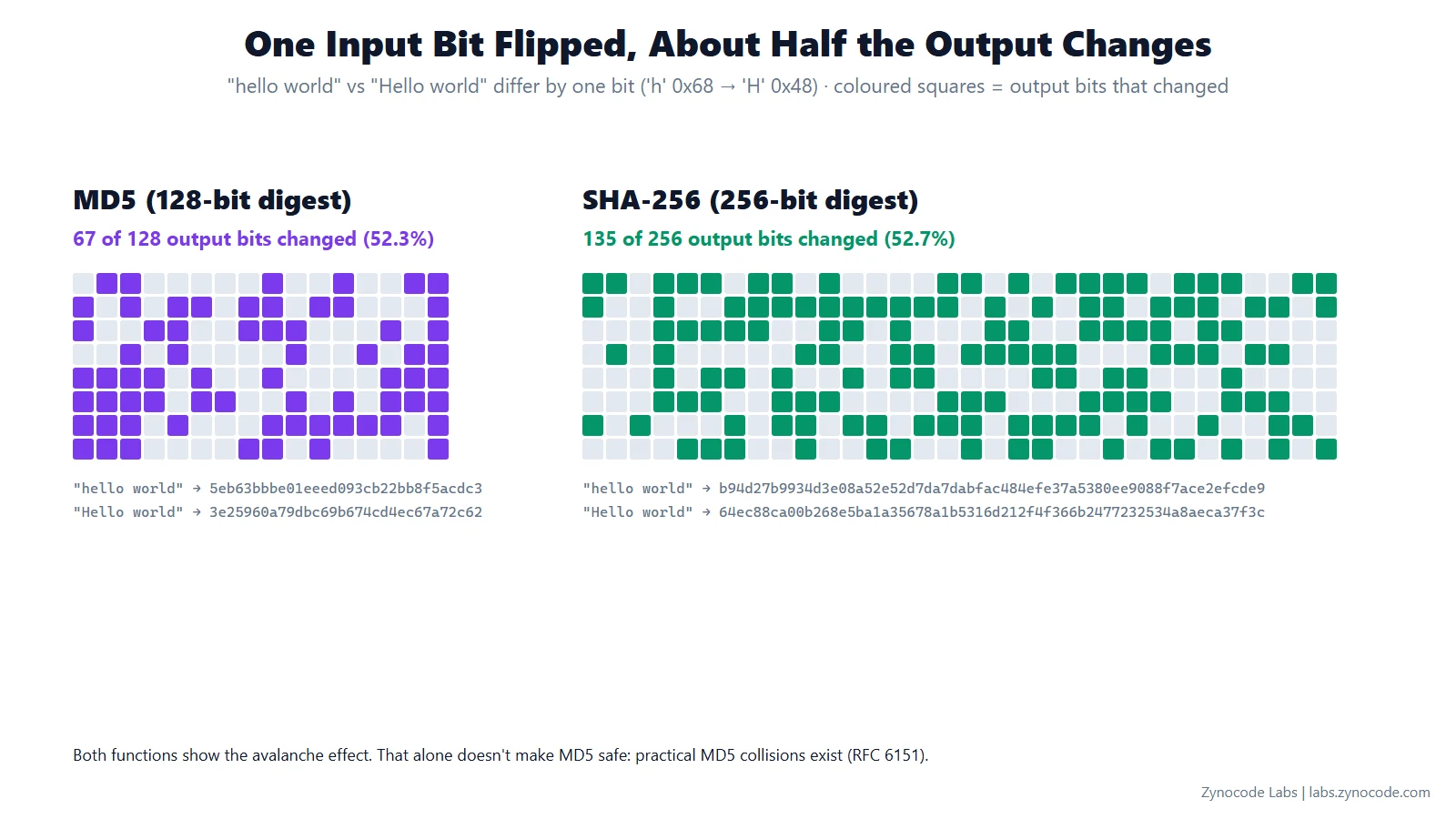
A fundamental requirement of cryptographic hash functions is the avalanche effect: flipping a single input bit must cause a cascade of non-linear alterations, changing roughly 50% of the output bits in an unpredictable manner.
Let us test two inputs that differ by exactly one single bit using our upgraded Hash Generator and verify the outputs:
- Input 1:
hello world - Input 2:
Hello world
The only difference between these strings is the first character: lowercase 'h' (ASCII code 104, binary 01101000) versus uppercase 'H' (ASCII code 72, binary 01001000). Exactly one single bit is inverted.
Output Digests for "hello world"
- MD5:
5eb63bbbe01eeed093cb22bb8f5acdc3 - SHA-256:
b94d27b9934d3e08a52e52d7da7dabfac484efe37a5380ee9088f7ace2efcde9
Output Digests for "Hello world"
- MD5:
3e25960a79dbc69b674cd4ec67a72c62 - SHA-256:
64ec88ca00b268e5ba1a35678a1b5316d212f4f366b2477232534a8aeca37f3c
Avalanche Bit Analysis
When we compute the Hamming distance (the count of inverted bits) between the two digests:
- MD5 Avalanche: Across the 128 output bits, flipping the single bit in
'h'causes 67 of 128 bits to flip (an avalanche ratio of 52.3%). - SHA-256 Avalanche: Across the 256 output bits, flipping that same single bit causes 135 of 256 bits to flip (an avalanche ratio of 52.7%).
Both algorithms demonstrate near-ideal avalanche behavior close to the theoretical 50% target. However, only SHA-256 preserves the mathematical structure necessary to maintain collision resistance under rigorous cryptanalysis.
When formatting digital signatures or token payloads for distributed systems, explore our guide on JWT structure explained to learn how cryptographic signatures validate claims in production.
Summary: Which Hash Algorithm Should You Choose?
When selecting a hash function for your applications:
- Use SHA-256 for all security-sensitive tasks: HMAC API authentication, digital signatures, integrity verification of executable binaries, git commit tree verification, and regulatory compliance under NIST guidelines.
- Use MD5 solely for non-security checksums: local file transfer verification against transmission corruption, cache lookup tags, and legacy archive verification where no malicious adversary is present.
- Use Argon2id, scrypt, or bcrypt for password storage and credential authentication. Never use raw general-purpose digests like MD5 or SHA-256 for user passwords.
Frequently asked questions
What is the primary difference between MD5 and SHA-256?+
MD5 produces a 128-bit digest and is cryptographically broken due to practical collision vulnerabilities. SHA-256 produces a 256-bit digest, is approved under NIST FIPS 180-4, and provides 128 bits of security strength against collision attacks with zero known collisions.
When is using MD5 still acceptable?+
MD5 is acceptable strictly for non-cryptographic tasks: detecting accidental file corruption during disk transfers, generating fast cache lookup keys (such as Gravatar hashes or CDN cache tags), or verifying legacy file archives where adversaries cannot alter payloads.
Why should you never use MD5 or SHA-256 for password hashing?+
Both MD5 and SHA-256 are high-speed general-purpose hash functions designed to process data rapidly. Modern GPUs can calculate billions of SHA-256 hashes per second. Password storage requires memory-hard key derivation algorithms like Argon2id, scrypt, or bcrypt.
What is the difference between a collision attack and a preimage attack?+
A collision attack finds any two arbitrary inputs that yield the same hash output. A preimage attack attempts to reverse a specific known hash back to its original input. MD5's collision resistance is completely broken, while its theoretical preimage resistance remains high.
Does SHA-256 have any known cryptographic collisions?+
No. Since its standardization by NIST in FIPS 180-2 and FIPS 180-4, there has never been a documented practical or theoretical collision discovered for full 64-round SHA-256.

Prashant Sharma · Founder & Technology Strategist
Prashant Sharma is the founder of Zynocode IT Solutions, specializing in web development, SEO tooling and generative AI workflows.