Passive Voice Examples: How to Spot and Convert Passive Sentences

Passive voice occurs when the subject of a sentence is acted upon by the verb rather than performing the action. For example, 'The report was written by Sarah' is passive, whereas 'Sarah wrote the report' is active. Active voice creates clearer, more concise sentences by placing the actor before the action.
Studying clear passive voice examples is the fastest way to understand the difference between active and passive constructions and strengthen your writing. While passive voice is grammatically correct, overusing it leads to wordy, indirect sentences where the person or entity responsible for an action remains obscured. Writers, editors, and students can audit drafts instantly in their browser using our free Passive Voice Detector.
The team launched the app). In passive voice, the subject receives the action (The app was launched by the team). Active voice improves clarity and reduces word count. To quickly identify passive sentences, check for a form of "to be" paired with a past participle, or test if you can add "by zombies" after the verb.What Is Passive Voice? Active vs. Passive Voice Explained
Passive voice is a grammatical construction where the subject of the sentence receives the action rather than performing it.
To understand how voice works in English grammar, examine the fundamental sentence structures:
- Active Voice Structure: Actor (Subject) + Action (Verb) + Target (Direct Object)
- Passive Voice Structure: Target (Subject) + Auxiliary "To Be" + Past Participle + [optional prepositional phrase: "by" + Actor]
The Purdue Online Writing Lab (OWL) puts it this way: "Using active voice for the majority of your sentences makes your meaning clear for readers, and keeps the sentences from becoming too complicated or wordy."
U.S. federal plain language guidance says the same. The plain language writing guide on Digital.gov states: "Active voice makes it clear who should do what."
Active vs. Passive Sentence Mechanics:
Active:   [ The Engineer ] ──( fixed )──► [ The Server ]
               Actor          Action          Target

Passive:  [ The Server ] ──( was fixed by )──► [ The Engineer ]
               Target             Action              Actor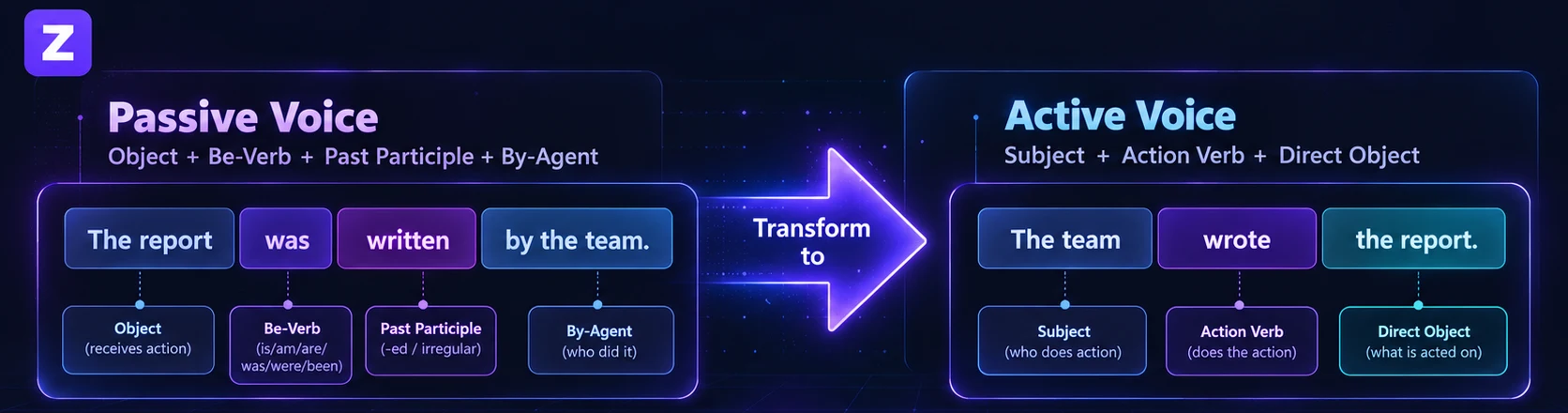
The "By Zombies" Test
A popular, practical heuristic taught by writing instructors is the "by zombies" test.
If you can insert the phrase "by zombies" immediately after the verb and the sentence remains grammatically coherent, the sentence is written in the passive voice:
- "The project was approved [by zombies]." (Grammatically sound; passive voice)
- "The team approved the project [by zombies]." (Illogical nonsense; active voice)
- "Mistakes were made [by zombies]." (Grammatically sound; passive voice)
- "We made mistakes [by zombies]." (Illogical nonsense; active voice)
If the phrase fits naturally, you have identified a passive construction.
20 Passive Voice Examples with Active Rewrites
The following table provides 20 real-world examples across business, technical, legal, and conversational contexts. Each sentence has been tested through our Passive Voice Detector to illustrate how automated pattern matching works in practice:
| # | Passive Voice Example | Active Voice Transformation | Tool Detection Status |
|---|---|---|---|
| 1 | The report was submitted by the team yesterday. | The team submitted the report yesterday. | Flagged (was + submitted) |
| 2 | A new marketing campaign was launched by the company. | The company launched a new marketing campaign. | Flagged (was + launched) |
| 3 | Mistakes were admitted by the executive during the interview. | The executive admitted mistakes during the interview. | Flagged (were + admitted) |
| 4 | The software update was installed by the administrator. | The administrator installed the software update. | Flagged (was + installed) |
| 5 | The decision was announced by the committee this morning. | The committee announced the decision this morning. | Flagged (was + announced) |
| 6 | The contract was drafted by our legal counsel. | Our legal counsel drafted the contract. | Flagged (was + drafted) |
| 7 | Customer complaints are tracked by the support team. | The support team tracks customer complaints. | Flagged (are + tracked) |
| 8 | The server was restarted by the engineer after midnight. | The engineer restarted the server after midnight. | Flagged (was + restarted) |
| 9 | The quarterly budget was approved by the board of directors. | The board of directors approved the quarterly budget. | Flagged (was + approved) |
| 10 | Security patches are deployed by the operations group. | The operations group deploys security patches. | Flagged (are + deployed) |
| 11 | The email was delivered to all subscribers. | The system delivered the email to all subscribers. | Flagged (was + delivered) |
| 12 | The website was redesigned by our in-house team. | Our in-house team redesigned the website. | Flagged (was + redesigned) |
| 13 | A security breach was discovered by researchers. | Researchers discovered a security breach. | Flagged (was + discovered) |
| 14 | The invoice was paid by the client on Friday. | The client paid the invoice on Friday. | Flagged (was + paid) |
| 15 | New guidelines were established by the department. | The department established new guidelines. | Flagged (were + established) |
| 16 | The article was written by the senior editor. | The senior editor wrote the article. | Flagged (was + written) |
| 17 | The database was built by our engineering team. | Our engineering team built the database. | Flagged (was + built) |
| 18 | The stolen credentials were found on the dark web. | Analysts found the stolen credentials on the dark web. | Flagged (were + found) |
| 19 | The database was accidentally deleted by a junior developer. | A junior developer accidentally deleted the database. | Flagged (was + deleted, skipping the adverb) |
| 20 | The web application got compromised during the attack. | Attackers compromised the web application during the attack. | Flagged (got + compromised) |
How Our Passive Voice Checker Detects Sentences (and What It Misses)
Understanding how automated tools detect passive voice helps writers evaluate software suggestions critically.
The Underlying Detection Rule
The checker looks at each sentence for a simple pattern:
- An auxiliary verb: a form of "to be" (
is,are,was,were,be,been,being,am) or of "get" (get,gets,got,gotten,getting). - Optionally one adverb ending in "-ly": so "was accidentally deleted" still counts.
- A past participle: a word ending in
-ed, or one of about 140 irregular forms such as "written", "built", "paid" and "found".
Common adjectives that end in "-ed" ("tired", "excited", "talented", "located") are skipped unless "by" follows them, as in "we were surprised by the results". When a sentence matches, it is underlined in blue, and the stats show how many sentences are passive and what share of the text that is. A "by zombies" switch inserts "[by zombies]" after each detected participle so you can apply the test from the start of this guide. The tool also checks for 22 common clichés (such as "think outside the box" or "low hanging fruit") and 22 conversational fluff words (such as "basically", "literally", and "actually").
Known Limitations and What the Pattern Misses
A rule-based check is fast and private, but it doesn't understand grammar the way a person does:
- Adjectives it doesn't know: "-ed" adjectives outside its list can still be flagged, for example "The room was crowded."
- More than one word in between: "was very quickly approved" is missed, because only one adverb is allowed between the verbs.
- Unusual irregular verbs: rare or uncommon participles that aren't on the list are missed.
- One match per sentence: a sentence with two passive clauses is counted once.
Because of these trade-offs, automated tools should serve as diagnostic aids rather than absolute arbiters. Combining automated checks with manual review produces the cleanest results.
How to Check for Passive Voice in Microsoft Word vs. Online Tools
Writers working in Microsoft Word can enable native passive voice detection:
- In Microsoft Word, open File and select Options.
- Click Proofing in the left-hand navigation pane.
- Under "When correcting spelling and grammar in Word", ensure Mark grammar errors as you type is checked.
- Next to "Writing Style", click the Settings... button.
- In the Grammar Settings dialog, scroll to Clarity and Conciseness and check the box for Passive Voice.
- Click OK to save your preferences.
Menu names vary between Word versions, and the check must be switched on manually. In contrast, our browser-based Passive Voice Detector requires no installation, runs on mobile and desktop, and processes text locally without transmitting drafts to cloud servers.
Before running an analysis on text copied from legacy documents, you can use our Text Cleaner to strip extraneous line breaks and trailing spaces.
When Passive Voice Is Actually the Right Choice
Despite the strong preference for active verbs, passive voice is not a grammatical error. It is a legitimate stylistic choice when used intentionally:
- When the Actor Is Unknown or Irrelevant: "The vehicle was stolen sometime before midnight." Mentioning that unknown thieves stole the car adds nothing; the focus belongs on the missing vehicle.
- Scientific and Technical Methodology: "Twenty milligrams of sodium chloride were dissolved in distilled water." In scientific papers, the methodology and reproducibility matter more than the individual researcher who poured the solution.
- Diplomatic Tact and De-emphasizing Blame: "A mistake was made during the billing cycle." Passive voice allows organizations to acknowledge an error without publicly singling out an individual employee.
- Focusing on the Result or Recipient: "The historic library was destroyed by fire." The library is the central subject of public interest, not the flames.
Impact on Readability and User Engagement
Passive constructions usually need more words than their active equivalents. They add auxiliary verbs ("was", "were", "has been") and, often, a "by the..." phrase. In the table above, most active rewrites are shorter than their passive originals.
While search engines like Google do not explicitly penalize passive voice in ranking algorithms, sentence structure directly affects human engagement:
- Long, winding sentences lower reading velocity.
- Unclear actor-verb relationships create cognitive fatigue.
- Dense prose inflates reading difficulty scores.
You can verify the structural impact of active rewriting using our Readability Checker. Converting passive sentences to active voice usually shortens sentences, which tends to raise your Flesch Reading Ease score, as explained in our detailed guide on readability score flesch kincaid explained.
Summary
Active voice drives energetic, transparent writing. By placing the actor before the action, you eliminate ambiguity, cut unnecessary syllables, and keep readers engaged.
Ready to polish your writing? Paste your draft into our free Passive Voice Detector, review highlighted sentences, and convert passive constructions into direct, active prose. For more copywriting tutorials and diagnostic utilities, browse our full collection of developer and writer guides.
Frequently asked questions
What is passive voice with an example?+
Passive voice is a sentence construction where the grammatical subject receives the action rather than performing it. In 'The ball was thrown by Mark', the ball is the subject receiving the action. In active voice, it becomes 'Mark threw the ball'.
How do you identify passive voice quickly?+
Look for a form of the verb 'to be' (am, is, are, was, were, be, been, being) paired with a past participle. A helpful informal test is checking whether you can insert 'by zombies' after the verb.
Why do editors prefer active voice over passive voice?+
Active voice makes sentences direct, vigorous, and concise. It clarifies who is responsible for the action and reduces unnecessary auxiliary words, making complex material easier for readers to understand.
When is passive voice appropriate to use?+
Passive voice is useful when the person performing the action is unknown, obvious, or less important than the result. It is standard in scientific methodology, legal drafting, and news reporting where focus belongs on the event.
How does our online passive voice checker work?+
Our tool scans text locally in your browser for 'to be' auxiliary verbs followed immediately by past participles ending in -ed. It highlights detected passive sentences with a blue underline without transmitting your text to external servers.

Prashant Sharma · Founder & Technology Strategist
Prashant Sharma is the founder of Zynocode IT Solutions, specializing in web development, SEO tooling and generative AI workflows.