Flesch Reading Ease Explained: Formulas, Score Meaning & Charts
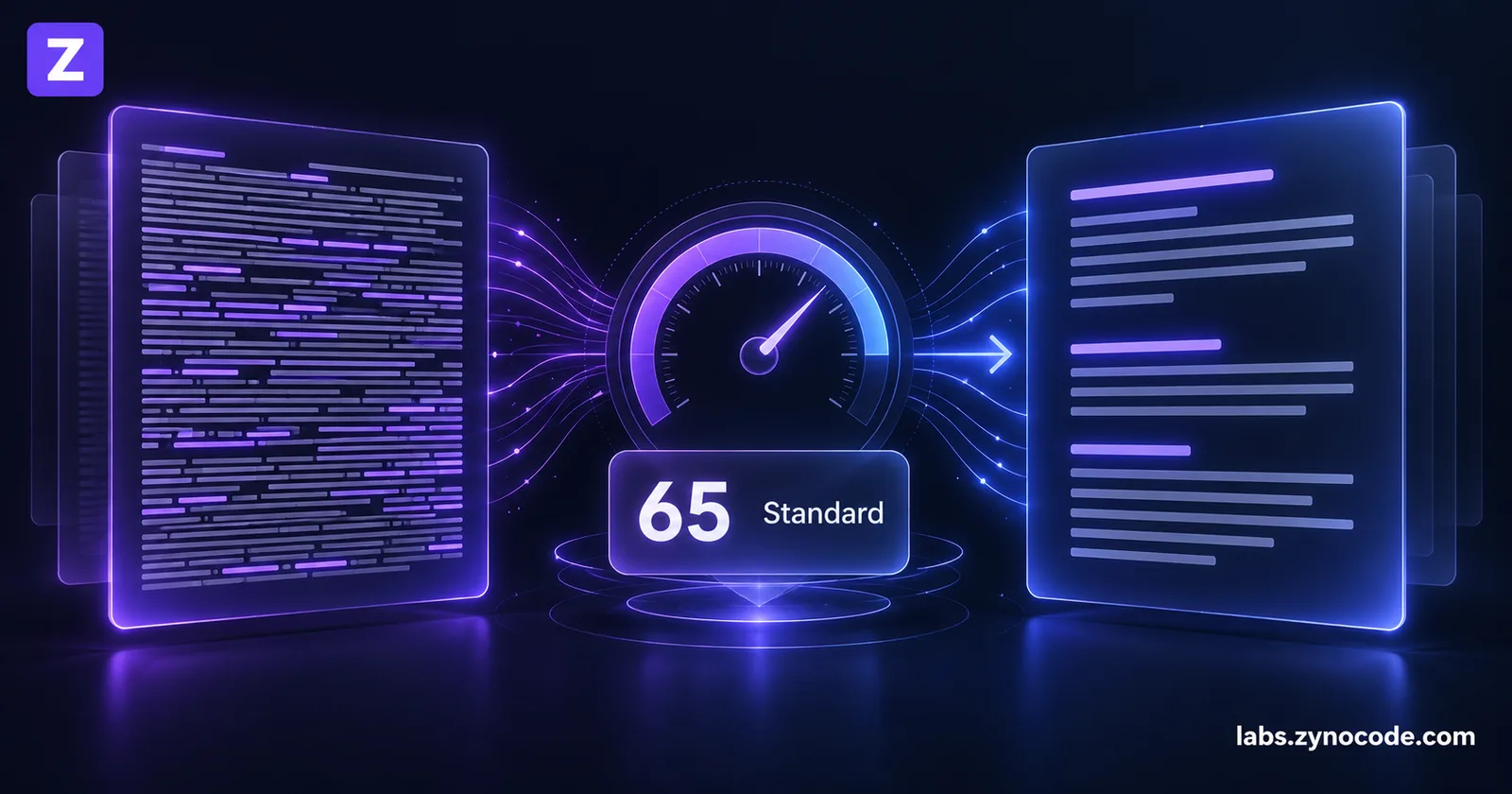
Flesch Reading Ease is a readability formula that evaluates English text complexity on a scale from 0 to 100. Calculated using average sentence length and average syllables per word, higher scores reflect simpler reading. Scores between 60 and 70 represent standard web readability, corresponding roughly to an eighth-grade reading level.
Understanding the Flesch Reading Ease formula is essential for writing clear digital copy that readers can absorb without frustration. When readers encounter dense sentences loaded with polysyllabic jargon, bounce rates rise and engagement drops. Whether you are drafting blog posts, compliance disclosures, or technical guides, scoring your draft with our browser-based Readability Checker provides immediate insight into text accessibility.
What Is Flesch Reading Ease?
Flesch Reading Ease is a standardized mathematical test designed to assess the reading comprehension difficulty of English text. Developed in 1948 by educational researcher Rudolf Flesch in his paper A new readability yardstick (published in the Journal of Applied Psychology), the index scores passages on a 0-to-100 scale.
Unlike subjective editorial feedback, the Flesch index evaluates two objective structural attributes:
- Syntactic Complexity: Measured by Average Sentence Length (words divided by sentences). Longer sentences strain reader working memory.
- Semantic Complexity: Measured by Average Syllables per Word (syllables divided by words). Words containing three or more syllables generally require higher vocabulary comprehension.
When a document pairs short sentences with compact words, its Reading Ease score rises. When it combines sprawling clauses with complex terminology, its score plunges toward zero.
How the Readability Formulas Work
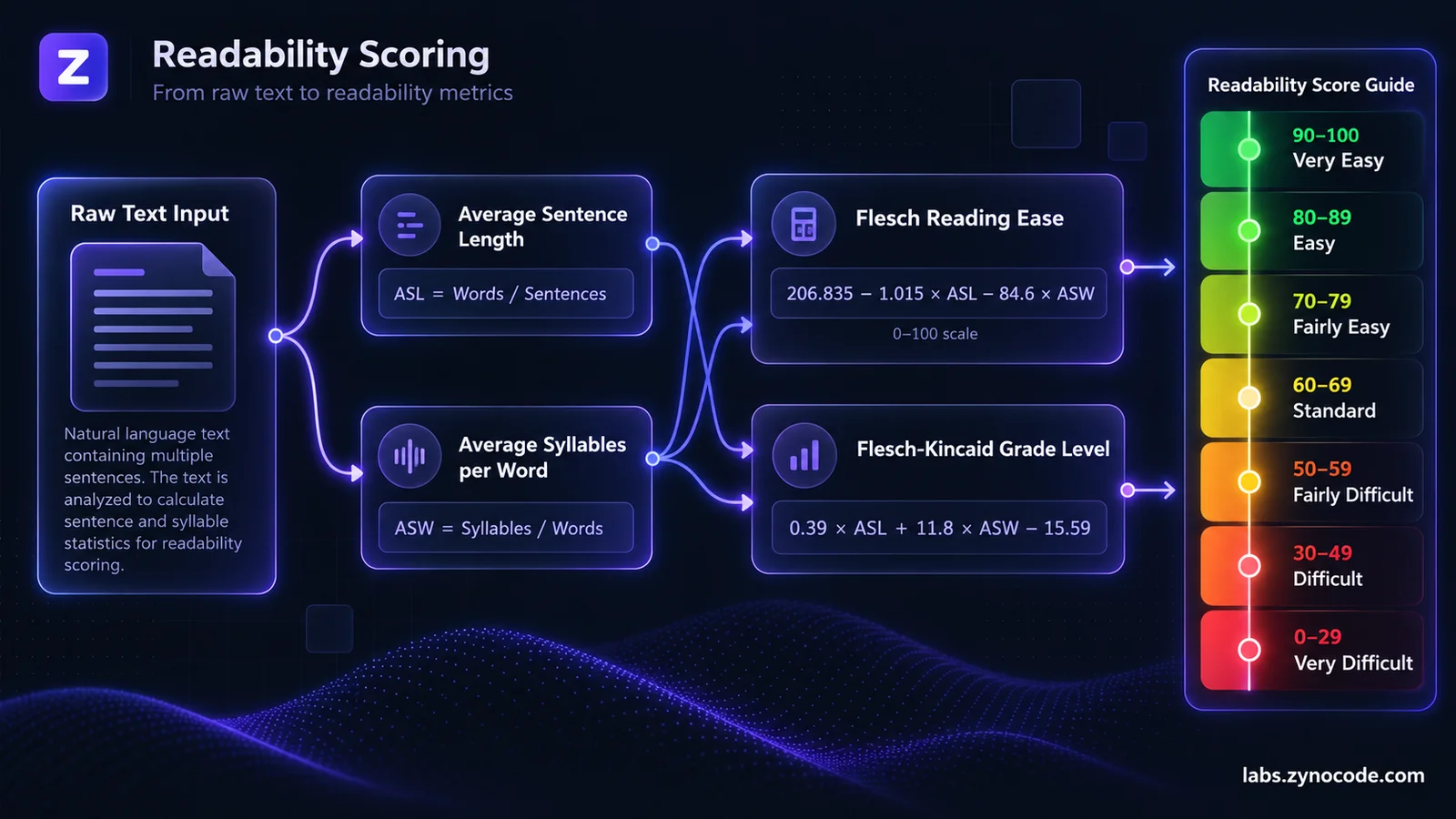
Two closely related formulas dominate modern writing analysis: Flesch Reading Ease and the Flesch-Kincaid Grade Level.
1. The Flesch Reading Ease Formula
Rudolf Flesch established the following equation to calculate reading ease:
Reading Ease = 206.835 - 1.015 * (Total Words / Total Sentences) - 84.6 * (Total Syllables / Total Words)In this formula:
- 206.835 is the baseline intercept constant.
- 1.015 weights the average sentence length (ASL).
- 84.6 weights the average syllables per word (ASW).
Scores typically range from 0 to 100, though extremely simple sentences can calculate above 100, and academic legal text can drop below zero. In software implementations, tools frequently clamp the visible score between 0 and 100.
2. The Flesch-Kincaid Grade Level Formula
In 1975, Navy researcher J. Peter Kincaid and his colleagues recalibrated Flesch's work for military technical training manuals. Published by the Naval Technical Training Command as Research Branch Report 8-75 (available through the U.S. Department of Education ERIC database as ED108134), the Flesch-Kincaid Grade Level translates reading difficulty directly into U.S. academic grade levels:
Grade Level = 0.39 * (Total Words / Total Sentences) + 11.8 * (Total Syllables / Total Words) - 15.59A calculated score of 8.0 indicates that an average eighth-grade student (roughly 13 to 14 years old) can comprehend the text on first reading.
Worked Calculation Examples
To understand how the arithmetic works in practice, examine these two worked examples. Each shows raw counts, intermediate averages, and final rounded results verified against our Readability Checker.
Worked Example 1: Clear Web Copy
Consider this concise, reader-friendly passage:
Let us extract the structural counts:
- Total Words: 15
- Total Sentences: 2
- Total Syllables: 22 (Clear: 1, writing: 2, helps: 1, users: 2, finish: 2, tasks: 1, quickly: 2; Short: 1, words: 1, keep: 1, your: 1, message: 2, simple: 2, and: 1, direct: 2)
Step-by-step arithmetic:
- Average Sentence Length (ASL): 15 / 2 = 7.50 words per sentence.
- Average Syllables per Word (ASW): 22 / 15 = 1.467 syllables per word.
- Flesch Reading Ease Calculation: 206.835 - (1.015 * 7.50) - (84.6 * 1.467) = 206.835 - 7.6125 - 124.108 = 75.115, which rounds to 75 ("Fairly Easy").
- Flesch-Kincaid Grade Level Calculation: 0.39 * 7.50 + 11.8 * 1.467 - 15.59 = 2.925 + 17.311 - 15.59 = 4.646, which rounds to 4.6 (approximately 4th to 5th grade level).
Worked Example 2: Standard Informational Copy
Now examine a slightly longer, standard explanatory sample:
Let us extract the structural counts:
- Total Words: 18
- Total Sentences: 2
- Total Syllables: 28
Step-by-step arithmetic:
- Average Sentence Length (ASL): 18 / 2 = 9.00 words per sentence.
- Average Syllables per Word (ASW): 28 / 18 = 1.556 syllables per word.
- Flesch Reading Ease Calculation: 206.835 - (1.015 * 9.00) - (84.6 * 1.556) = 206.835 - 9.135 - 131.638 = 66.062, which rounds to 66 ("Standard").
- Flesch-Kincaid Grade Level Calculation: 0.39 * 9.00 + 11.8 * 1.556 - 15.59 = 3.51 + 18.361 - 15.59 = 6.281, which rounds to 6.3 (approximately 6th grade level).
Both examples demonstrate that modest increases in average word length and sentence length produce substantial shifts in overall readability metrics.
Flesch Reading Ease Score Bands Table
The standard interpretation framework organizes scores into seven distinct bands:
| Flesch Reading Ease | Difficulty Rating | Flesch-Kincaid Grade | Target Audience & Example Media |
|---|---|---|---|
| 90–100 | Very Easy | 5th grade | 10 to 11-year-olds; children's books and comics |
| 80–89 | Easy | 6th grade | 11 to 12-year-olds; casual conversation, simple pulp fiction |
| 70–79 | Fairly Easy | 7th grade | 12 to 13-year-olds; consumer product copy, news previews |
| 60–69 | Standard | 8th to 9th grade | 13 to 15-year-olds; mainstream web articles, blogs, mass media |
| 50–59 | Fairly Difficult | 10th to 12th grade | High school students; trade publications, technical essays |
| 30–49 | Difficult | College level | Undergraduate students; academic journals, whitepapers |
| 0–29 | Very Difficult | College Graduate | Specialized professionals; statutory law, scientific research |
Target Scores by Content Type
Not all writing should aim for the same score. The ideal readability target depends on your audience and the medium:
| Content Type | Suggested Reading Ease | Suggested Grade Level | Strategic Goal |
|---|---|---|---|
| Consumer Blogs & Marketing | 60–70 | 7th–8th grade | Maximum engagement, effortless scanning, low cognitive friction |
| Product & Medical Labels | 70–80 | 6th–7th grade | Immediate consumer comprehension and compliance safety |
| B2B Technical Guides | 50–60 | 9th–10th grade | Clear professional explanations without oversimplifying domain concepts |
| Legal & Financial Disclosures | 40–50 | 11th–12th grade | Regulatory compliance while minimizing ambiguous interpretation |
These targets are editorial starting points, not official standards. Some regulated industries do set hard minimums, though. For example, Florida's insurance law (Fla. Stat. § 627.4145) deems a policy readable only if the text "achieves a minimum score of 45 on the Flesch reading ease test" (among other requirements).
The Serious Flaw in Readability Formulas
While readability metrics offer valuable quantitative benchmarks, they measure syntax, not clarity.
In *A Plain English Handbook: How to create clear SEC disclosure documents*, the U.S. Securities and Exchange Commission (SEC) warns writers against treating formulas as an infallible seal of quality:
The handbook adds that, for the most part, these formulas count syllables and words. That means a passage of short, disconnected sentences can score very high while still failing to explain anything clearly. True readability requires coherent narrative structure, logical headings, and thoughtful context.
12 Concrete Rewriting Techniques to Improve Readability
If your draft scores in the "Difficult" or "Fairly Difficult" range, use these 12 actionable editorial techniques to raise your score:
- Split Sprawling Compound Sentences: Locate conjunctions like "and", "but", and "although". If both clauses can stand alone, divide them into two concise sentences.
- Swap Latinate Jargon for Anglo-Saxon Roots: Replace polysyllabic words with short equivalents. Use "help" instead of "facilitate", "end" instead of "terminate", and "show" instead of "demonstrate".
- Eliminate Passive Voice: Passive constructions add auxiliary verbs and invert subject-object relationships. Highlight and eliminate passive sentences using our Passive Voice Detector.
- Remove Unnecessary Duplicate Words: Repeated modifiers inflate word counts without adding value. Weed out redundant terms using our Duplicate Word Finder.
- Trim Throat-Clearing Preamble Phrases: Delete filler introductions like "it is important to note that" or "as a matter of fact". Start sentences directly with the actor and action.
- Uncover Buried Nominalizations: Convert abstract nouns back into active verbs. Change "conduct an investigation into" to "investigate", and "reach an agreement" to "agree".
- Use Bulleted Lists for Series: Whenever a sentence contains three or more items, convert the series into a bulleted or numbered list to reduce visual fatigue.
- Front-Load Subjects and Main Verbs: Keep the grammatical subject and its corresponding verb close to the start of the sentence to reduce working memory load.
- Eliminate Nested Parenthetical Clauses: Extensive text wrapped in parentheses or dashes forces readers to pause. Move secondary thoughts into independent sentences.
- Break Walls of Text into Short Paragraphs: Keep web paragraphs between two and four sentences. Generous white space prevents readers from feeling overwhelmed.
- Audit Total Length and Syllables: Run your text through a Word Counter to check overall length and reading time.
- Verify Keyword Balance Without Stuffing: When optimizing articles for search engines, ensure natural phrasing without repetitive keyword stuffing by following our guide on what is keyword density.
How Our Readability Checker Works
Our free browser-based Readability Checker analyzes your text in real time as you type or paste:
- Real-Time Word and Sentence Counters: Automatically counts words using whitespace boundary detection and sentences using terminal punctuation markers (
.,!,?). - Syllable Counting Heuristics: Evaluates vowel clusters and word-ending rules to approximate syllable counts per word. Because English contains irregular loanwords and silent vowels, regex-based counting is an estimate, not a dictionary lookup, so scores can differ slightly from other tools.
- Dual Score Display: Calculates both the 0-to-100 Flesch Reading Ease score and the corresponding Flesch-Kincaid Grade Level.
- Dynamic Feedback Card: Displays a color-coded status badge (from green "Very Easy" to red "Very Difficult") and, for scores below 60, a suggestion to shorten sentences and use simpler words.
- Client-Side Privacy: The entire analysis runs locally in your browser. No drafts, proprietary memos, or personal essays are transmitted across external networks.
Summary
The Flesch Reading Ease score is one of the most reliable diagnostic tools in modern writing. By monitoring sentence length and syllable density, writers can strip away unnecessary complexity, lower cognitive friction, and produce content that communicates clearly to their audience.
Ready to measure your draft? Paste your writing into our free browser-based Readability Checker, inspect your grade level, and apply structural refinements before publishing. For more writing optimization tools and tutorials, explore our comprehensive library of developer and writer guides.
Frequently asked questions
What is Flesch Reading Ease?+
Flesch Reading Ease is a formula that scores English text from 0 to 100 based on sentence length and syllable count. Higher scores indicate easier reading. A score of 60 to 70 is standard for web content.
What is a good Flesch Reading Ease score for websites?+
A score between 60 and 70 is standard for consumer websites, blogs, and marketing copy. This corresponds to an 8th-grade reading level, ensuring that most adults can read and understand the material quickly.
How does Flesch-Kincaid Grade Level differ from Reading Ease?+
While Flesch Reading Ease rates text on a 0-to-100 scale, Flesch-Kincaid Grade Level reports the required U.S. school grade. A Reading Ease score of 60 to 70 translates roughly to an 8th-grade level.
Why is syllable counting in readability tools an estimate?+
Readability tools estimate syllables using rule-based regular expressions rather than phonetic pronunciation dictionaries. While accurate for most English prose, irregular words and silent letters can cause minor count variations.
Can a high readability score guarantee clear content?+
No. Readability formulas measure only sentence length and syllable density. As the SEC notes, formulas cannot evaluate factual clarity, document organization, or meaning. Clear writing still requires logical structure and precise explanation.

Prashant Sharma · Founder & Technology Strategist
Prashant Sharma is the founder of Zynocode IT Solutions, specializing in web development, SEO tooling and generative AI workflows.